Research that’s reshaping the future of hearing.
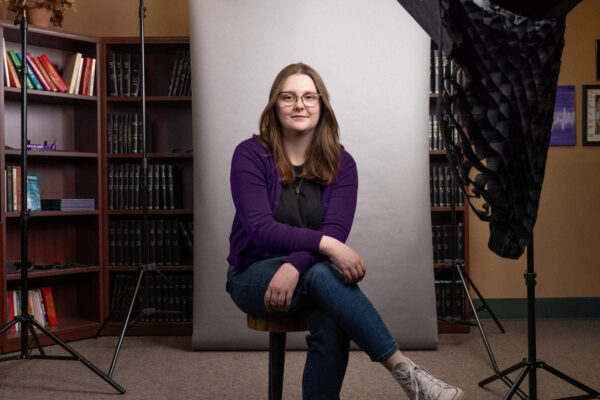
Above: Early intervention and lived experience is shaping the life of student Paige Stickney. (Photo by Frank Neufeld)
When Paige Stickney walked into Susan Scollie’s lab last summer, she felt like she was stepping back in time. She’d been here before. Stickney paused, recalling that 10 years prior she participated in one of Scollie’s research studies at Western’s National Centre for Audiology (NCA).
Now she was back — as an undergraduate summer research intern at one of the leading global institutes for audiology research. “It was a big full-circle moment,” says Stickney, a fourth-year linguistics major in the Faculty of Arts and Humanities. She didn’t just return to a lab. She entered a world that had shaped her experience of sound from the very beginning.
Stickney was one of three in every 1,000 babies born with permanent hearing loss. A lack of oxygen during delivery damaged the sensory hair cells in her cochlea — a fluid-filled, delicate structure in the inner ear.
“My parents were terrified,” Stickney says.
Everything had happened so fast. A rush to the operating room, an emergency C‑section. And then news their baby needed a hearing test.
“My mom doesn’t remember a lot, but it was traumatic.” Stickney was immediately referred to the H.A. Leeper Speech and Hearing Clinic at Western, which offers evidence-based speech, language and audiology services to London, Ont., and surrounding areas. The clinic is the training site for master’s students in speech language pathology and audiology, both offered through the School of Communication Sciences and Disorders in the Faculty of Health Sciences, which also houses the NCA.

After a whirlwind of worry about what Paige might miss, the Leeper Clinic offered her parents a calming perspective.
“The staff were extremely sensitive,” Stickney says. “They told my mom I wouldn’t miss what I wasn’t hearing, because I was born this way.”
From the comfort of a parent’s voice to the chatter of family and friends, access to language connects us to the people and the world around us—and plays a critical role in how we communicate, think and develop.
For millions, deafness and hearing loss are part of that connection. According to the World Health Organization, over five per cent of the world’s population is deaf or hard of hearing. By 2050, that number is expected to surpass 700 million—roughly one in 10 people.
For those who use spoken language, this rising prevalence of hearing loss underscores the importance of audiology research—and the ongoing work of the NCA.
For 25 years, this interdisciplinary team has advanced research in early screening programs, patient care and the evaluation of hearing technologies. Its work has also led to widely used innovations, including the world’s first pediatric hearing prescription and cochlear implant programming tailored to individual anatomy.
“We have a long history of collaboration, bringing together audiologists with basic scientists and engineers to innovate and solve problems,” says Scollie, Distinguished University Professor in the Faculty of Health Sciences and director of the NCA.
Communication sciences and disorders professor Sheila Moodie is one of those principal investigators. She’s also the director of the Family-Centred Early Intervention Lab, one of 16 research labs within the NCA.
For families like Stickney’s, learning an infant has hearing loss can be overwhelming, making empathetic care crucial in those early days, Moodie says.
“Families who’ve just had a baby are transitioning to their new roles as parents,” she says. “When they find out their newborn has been diagnosed with hearing loss, it’s normal to experience distress, uncertainty and fear.”
Through her lab, Moodie’s team ensures audiologists and other professionals engage caregivers in practical, supportive ways. Families are paired with trained support workers, connected to resources to navigate services and matched with peer families who understand what they’re experiencing.
With the right tools and support, Moodie says the goal is “to provide knowledge and hope” so families dealing with a child’s hearing loss can live as any other family would.
But early detection is key, says Marlene Bagatto, a professor in the School of Communication Sciences and Disorders and an NCA principal investigator.
“If a baby born with hearing loss is not identified early, intervention is delayed. This can affect their communication, social and cognitive development and access to education. Ultimately, it affects their ability to thrive and contribute to society.”
Bagatto’s research focuses on early hearing loss detection and supports for infants and young children.
Not all families are connected to specialists as early as Stickney’s was. Currently, only six out of Canada’s 13 provinces and territories provide comprehensive infant hearing health care. Bagatto is working to change that through evidence-based research. As a member of the Canadian Infant Hearing Task Force, she advocates to the federal government for equitable infant hearing health care across the country.
Early intervention includes signed or spoken language development services. For many children, this also involves assessments and the fitting of hearing aids or cochlear implants.
Hearing aid fittings require special consideration because each baby’s hearing and ear canal acoustics are unique and change as they grow. With no way for infants to say whether a hearing aid is too loud or too soft, precision is essential. “We really have to nail it,” says Scollie, an audiologist globally recognized for her expertise in hearing technologies and hearing-aid fitting.
So how do you test a baby’s hearing and hearing aids when they can’t respond verbally?
That was the question audiologists faced in the 1960s and ‘70s after a rubella outbreak resulted in a sudden wave of infants born with hearing loss. It underscored the need for robust hearing protocols for babies and young children.
Western professor emeritus Richard Seewald, former Canada Research Chair in Childhood Hearing, took up the challenge. Beginning with pencil-and-paper calculations, then a calculator, floppy discs and an early Atari computer, he pioneered a prescription software program for hearing aids for babies and young children. Known as Desired Sensation Level (DSL), the software has since become the gold standard of pediatric hearing-aid fitting.
DSL uses readings from electrodes placed on the baby’s head to measure how the brain responds to sound, helping clinicians calculate exactly how much amplification is needed.
Today, DSL is used by 80 to 90 per cent of clinicians worldwide for children’s fittings. It is trademarked and licensed through Western’s technology transfer office, with manufacturers sending their software back to the NCA for accuracy testing.
Building on Seewald’s foundational work, Scollie led an NCA team to develop DSL 5. This version accommodates advances in hearing aid technology and individual user needs of both children and adults, earning the team a 2022 Governor General’s Innovation Award.
With high-quality hearing-aid fitting a key predictor of speech and language development in children with hearing loss, earmolds are the critical link. These custom-fitted pieces connect the hearing aid to the child’s ear, ensuring sound is properly and consistently delivered. But young children’s ears grow quickly, meaning they frequently outgrow their earmolds. That causes the aids to fall out or whistle, disrupting a consistent delivery of sound. Scollie is working with engineering colleagues to address this problem through the ALLEars project (learn more in A collaborative high‑tech approach to an old problem). Like the origins of DSL, this research addresses a longstanding challenge.
“This has been a perennial problem in my field for as long as I can remember,” Scollie says.
DSL has improved hearing outcomes and the long-term educational and social potential for countless children born with permanent hearing loss—including Stickney, who received her first hearing aid at the Leeper Clinic at age three and whose high-frequency hearing loss meant she couldn’t distinguish soft sounds like “f” and “s.”
“Before I started wearing my hearing aid, my mom says when it was snowing, I’d sit in the back seat of the car, pointing out the window, saying, ‘Look, it knowing, it knowing!’ I had never heard the “s” sound before and hadn’t started reading yet, so I didn’t know it existed.”
When she began reading, Stickney excelled, moving through levels faster than her peers. She preferred reading books on her own, rather than hearing her teacher’s voice transmitted through the microphone system she had to wear in class.
“I loved words and I loved language,” Stickney says.
But she didn’t love wearing her hearing aids. “Some of it could have been comfort, but I think it was mostly the stigma I felt as a young child who didn’t see any representation in the media or in toys. I looked for role models with hearing loss and I couldn’t find any. That made me resistant and a bit of a troublemaker when it came to wearing my hearing aids.”
So much so that she and her mother struck a deal: if Stickney wore her hearing aids at school, she could take them out at home.
“I was never bullied, but I felt ostracized. It wasn’t overt. Schools are just full of big groups of people talking at once. I can’t be part of those conversations because I only get bits and pieces. I was always quiet in those situations because I couldn’t understand people.”
It was even worse on the playground.
“Kids are screaming, running around and with the wind rubbing your hair against your hearing aids, it makes it hard to hear conversations. You can only ask a child to repeat themselves so many times before they say, ‘never mind,’” Stickney says.
“If you don’t know what’s going on around you, hearing loss can be incredibly isolating.”
As Stickney grew, so did her acceptance of her hearing aids. “It took me a long time to be comfortable with having hearing loss and the fact I wear hearing aids and need extra help. But now, I know it’s nothing to be ashamed of.”
Through regular trips to audiologists Frances Richert and Jack Scott at Western’s Leeper Clinic, Stickney’s gone from wearing behind-the-ear hearing aids held in place by earmolds to the current receivers she wears in her ear canals.
She says she’s benefited from rapid advances in hearing aid technologies—like those tested and trialed through the NCA—and the support she’s received from the audiologists and trainees at the Leeper Clinic.
“They are so patient-centred and care about what you want and need. Their goal is to make living with hearing loss a better experience. I’ve always loved being a patient there. They helped me be okay with going to audiology appointments.”
She also credits the clinic for helping her develop a “quiet, subtle love for audiology.” It was Richert, Stickney’s childhood audiologist, who suggested she consider a career in the field. Though it didn’t interest her at the time, the idea began taking hold when she was a teenager. It crystallized during one of her clinic visits with a student audiologist—who was hard of hearing.
“It was so cool to be on the other end of the microphone system, so she could hear me,” Stickney says.
It meant even more to see someone with hearing loss training to be an audiologist.
“In that moment, I realized my hearing loss was not an inhibitor. I saw I could pursue audiology or anything I wanted. Having that representation really impacted me and helped me realize I can positively affect others.”
She’s one step closer. This fall, Stickney enters Western’s master of clinical science program in audiology, the largest of its kind in North America.
“It was always my dream to come to Western because I saw how they train their students,” she says. “I want to be trained in the same way.”
Eager to gain early experience, Stickney was “beyond excited” to land the research internship in Scollie’s lab last summer. Alongside postdoctoral scholar Mohamed Rahme, Stickney studied how different types of sports helmets affect hearing aid performance and a person’s ability to hear, communicate and stay safe during physical activity.
Early findings showed the more padding in the helmet, the greater the reduction in external noise and the more likelihood for feedback.
“This made sense to me. I was never very sporty or athletic, and part of that was because wearing helmets with hearing aids was awful,” Stickney says. “They go right over your ears. It’s not comfortable and you get feedback.”
A class skating trip in elementary school stands out.
“We all had to wear hockey helmets for safety, but it was the worst experience for me. I told the teacher if I couldn’t take my hearing aids out, I would not be skating.”
Stickney’s experience points to missed opportunities and potential dangers for children who are hard of hearing and want to participate in sports.
“If your coach is 20 feet away and you’re not facing them or you’re experiencing feedback from your hearing aids, you’re not going to catch the proper instruction. That’s unfortunate,” Stickney says. “It’s also dangerous if you are skiing or skating and can’t hear sounds behind you.”
She’s hoping the lived experience she brought to her internship will also help her relate to future patients, including aging adults, who are often reluctant to wear hearing aids.
“When I hear them resisting, I see bits of my younger self in them. I’ve ‘been there, done that,’ and want to tell them there are worse things than wearing hearing aids. They’re just a tool to help.”
Hearing aids do help significantly to amplify sound and restore hearing. But as NCA principal investigator and cognitive neuroscientist Ingrid Johnsrude explains, they don’t always mitigate the additional challenge many older adults with hearing loss face: background noise and competing voices. She’s studying how the brain makes sense of sound in the din of daily life—busy coffee shops, family gatherings—as we age (read more in Cutting through the noise).
“Our goal is to understand what processes are happening in the brain when we hear speech in noisy environments, particularly when someone has hearing loss,” she says. “Humans are social creatures, and our ability to communicate with each other is crucially dependent on our hearing. It commonly starts to fail in middle age, putting people at risk for social isolation.”
Stickney can relate, even as a young adult and with hearing technology that makes such a difference in her life.
“I will miss parts of conversations, even when wearing hearing aids, and sometimes I just won’t participate. Cars and busy areas are particularly bad. Imagine a wall between the front and back seat, that’s what it’s like trying to listen in a car. If I can’t see your face, I can’t hear you,” she says.
Despite the difficulties, she now can’t imagine her life without hearing loss.
How she listens—to people, to language and to possibilities in her own life—is part of her identity. “My ability to hear less shapes my world differently. Because of that, I wouldn’t trade it.”