
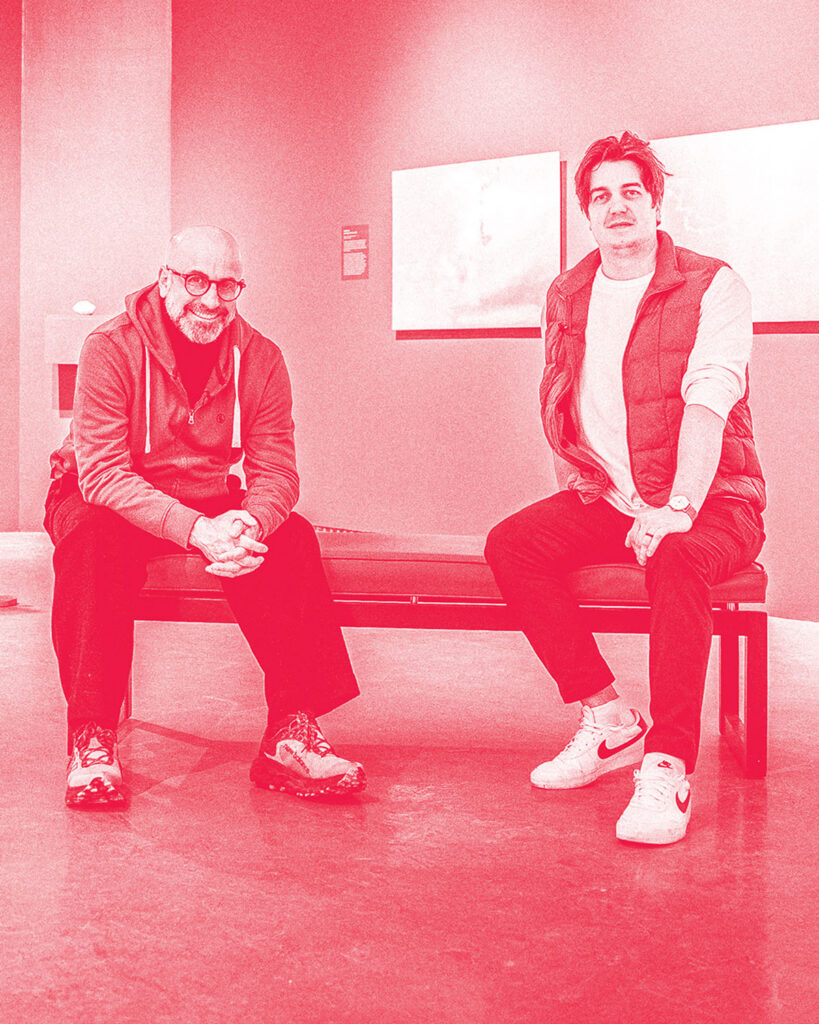
Inside Western’s McIntosh Gallery, founded in 1942 and shaped by decades of artistic tradition, writer Jeff Renaud sat down with Juan Luis Suárez, director of Western’s CulturePlex Lab, and Jeffrey Lupker, music professor and co‑founder of Staccato AI, to discuss where creativity is headed in an era of generative AI.
In ancient Greek drama, deus ex machina described a moment when a god appeared to solve a human problem—god from the machine. Now, in the age of generative AI, this dynamic has flipped. Instead of gods descending into a human-conceived story, we have built machines that appear to possess godlike capabilities—writing, composing music, generating images and videos and even collaborating creatively.
In that sense, generative AI is a kind of ‘machina ex deus’—machine from the god. The ‘god’ in this metaphor isn’t divine. It’s human imagination, knowledge and culture: the vast body of language, art and ideas on which AI systems are trained. Out of that collective human intelligence comes the machine.
And now that the machine not only exists but thrives, it feeds back into the creative process. Rather than replacing creativity, AI begins to externalize parts of it, like the self-aware android Data from Star Trek: The Next Generation solving space mysteries in mere minutes after devouring all of Sherlock Holmes’ most famous cases.

AI as creative partner
Generative AI chatbots and large language models like OpenAI’s ChatGPT, Google’s Gemini and Anthropic’s Claude can generate drafts, remix styles, propose ideas and accelerate experimentation. In this computerized collaboration, the human role shifts from producing every element to directing, curating and shaping possibilities. Creativity becomes more conversational: provide a prompt, the system responds and the work evolves through iteration.
Seen this way, AI isn’t the end of creativity but rather a new creative instrument, much closer to the invention of the camera, the synthesizer or digital editing tools than to an autonomous author. Those technologies initially sparked fears about replacing artists, yet they ultimately expanded the vocabulary of creative expression.
“I define creativity to my students as the crafting of the self. That’s my starting point. I don’t pay much attention to the innovation side of the definition, which talks about the product or the outcome. Not because it’s not important, but because I try to focus on the human side,” says Juan Luis Suárez, a professor of Hispanic studies and director of Western’s CulturePlex Lab. “How do you craft yourself?”
For Suárez, creativity is less about producing a final work and more about the human journey: shaping identity, belief and purpose through creative action.
“How do you access your creativity? And what skills can we give you so you can keep doing that throughout your life and have a life of creation, no matter what you are? You could be a football player, a musician, a manager. The baseline question is: how do we help you craft your own self for your life?”
Founded by Suárez in 2010, CulturePlex brings together faculty and students to explore how human behaviour, language and relationships ripple across society, combining big questions with modern tools, including generative AI, to help find solutions. In one prime example, Suárez and his former PhD student Javier de la Rosa (now a research scientist at the National Library of Norway’s Artificial Intelligence Lab) coded a data set of 120,000 paintings from different periods to analyze human faces represented between the 13th and the 20th centuries. They investigated whether there is a single ‘indicator’ of perceived beauty to establish if it has changed over time.
It’s an approach that mirrors how creativity itself is evolving: human imagination, guided by curiosity and conviction, now collaborates with machines rather than competing against them.
Music professor Jeffrey Lupker is the founder of Staccato AI, a company he co-founded with fellow Western alum Jason Kowalczyk to develop AI tools for musicians. The startup was shaped in part by Lupker’s participation in the Western Accelerator in 2023, a Morrissette Institute for Entrepreneurship program. A lifelong musician with a parallel fascination for technology, Lupker began merging the two during his master’s degree and then in his PhD, where he composed a 25-minute string quartet using generative AI to push through creative blocks.
That work became the foundation for new software and eventually the core of his startup. At first, some colleagues found his actions unconventional, unethical and even sacrilegious. But he saw the future.

Tools, not authors
Now fueled by that experience, Lupker envisions Staccato not as a replacement but as a collaborative tool helping musicians refine ideas, expand sketches and solve small problems without ever taking over the creative vision.
“We’re like a friend in the studio with you: someone you trust who understands what you’re trying to accomplish,” says Lupker. “Typically, we try to solve a problem along the way for you. Creators arrive with an idea and then they ask us: ‘how can I develop this?’”
Lupker’s academic and professional experience reflects a larger shift in how creativity is conceived in the age of AI.
“When I think about creativity—especially with the conceit that AI is trying to assume the role of creativity in everything—it must be based on a belief system that doesn’t exist in the machine. You can fake creativity, to some degree, as we’re seeing with some AI models, but real creativity is going off the beaten path and truly believing in it,” says Lupker. “Even if everyone thinks it’s wrong and the odds of it being the next big thing are low, you push it forward. That’s creativity.”
Suárez agrees and believes this deeply human view of creativity helps explain why AI cannot replace it.
Sure, machines can generate output, but they can’t hold conviction, purpose or moral and aesthetic values. Real creativity requires the willingness to pursue ideas that might fail, to take risks and to believe in one’s path even when it diverges from convention. “It’s a value system attached to whatever you’re doing in the world. That attachment is as important as the process or the result,” says Suárez.
So if human creativity is about belief and identity, AI’s role is not to supplant that. That’s inhuman. It’s there only to enhance it.
“Before, if I needed an idea, I would go to the music library and pull every score that seemed related,” says Lupker. “I would listen and read until I found the moment that sparked something. AI does that but incredibly fast and across every direction at once. You still need the overall goal. But it can help you get there faster.”
This augmentation is not limited to music. Across media, AI enables creators to explore large datasets of human culture quickly—from images to text to sound—and to iterate in ways that were previously impossible. Yet the human remains central, directing the process, curating outputs and embedding meaning. “AI is neutral. It’s not judging you. Sometimes the value is simply that it will answer your questions or fix something for you without judgment. The goal is just to help you,” says Lupker.
The emotional dimension—or lack thereof—is critical. Creative work is vulnerable. Human collaboration can trigger criticism, ego clashes and at its worst, self-doubt. AI, by contrast, creates a safe space where experimentation is possible without fear. “The ability to work with a tool that doesn’t question you, the way another human or an audience might, creates a safe space in the creative process,” says Lupker.
That means effective AI should support creators by fitting naturally into how they already work, helping to explore ideas and solve problems rather than forcing them to change.
“Creators spend years figuring out what works for them. If you disrupt that process too much, they’re not going to use your tool. That’s where I think some big companies are getting it wrong. They’re trying to be disruptors. But right now, it shouldn’t be about disrupting how people create. It should be about helping them think through creation,” says Lupker. “A lot of these AI companies want to mass-produce music for people who have never created it before. And that’s fine. But real creators already have workflows. You don’t mess with that.”
And the implications of generative AI extend beyond individual creativity. These tools are part of larger technological systems that reshape human behaviour, culture and social structures.
“When we live with new technologies, they change how we think, feel and create,” says Suárez. “You might resist it, but history shows society changes anyway. And because today’s technologies spread so quickly, they reshape our habits, thinking and social structures on a massive scale. Not everyone experiences those changes in the same way, but change is inevitable.”
At the end of the day, human curation and judgment remain the ultimate filters. Creativity isn’t just about output. It’s about cultural resonance.

Human judgment at the core
The challenge, Suárez adds, is preparing people to navigate these technologies.
“Whether the outcome is ultimately positive or negative, the best approach—even in the worst-case scenario—is to train people and give them skills so they can survive in the new ecosystem created by the new technology,” says Suárez. “The reason I stay in academia, and at Western in particular, is that every year a new generation arrives. There is youth. There is life. And I hope they will be able to build something better.”
But how will our value system, and theirs, change with all these technologies? “I think there are two paths. One is embodiment: what you can draw from your own body, experiences and sensations. That embodied relationship with the world will always matter. Consciousness, as neuroscientists like Antonio Damasio suggest, is deeply connected to the body’s interaction with the environment: hunger, thirst and emotion. Creative people draw from those experiences,” says Suárez. “The other path is mediated systems: the technologies we use to produce and share ideas. If you want to be active in the world, you must also engage with the most advanced technologies available. These two worlds run in parallel. I don’t think we have to choose one or the other. We need both.”
This all traces back to the 1440s, when Johannes Gutenberg, widely credited with inventing the mechanical printing press, transformed the spread of knowledge. Or even further, to 868 AD in China, when the Diamond Sutra, the oldest surviving dated printed book, was produced using woodblocks. The broader pattern of human creativity has been intertwined with technology for centuries. Generative AI is simply the latest incarnation. Each shift has created new challenges, reshaped education and altered access to knowledge and culture.
Despite these disruptions, Suárez says humanistic values remain central. “The humanistic tradition has always been about passing knowledge from previous generations. We pass on the great actors, composers and ideas. But we’ve reached a moment in the digital age where there has been a fracture. We now must ask: ‘how do we help the next generation retrieve what they need for the future?’”
In this scenario, AI becomes the gateway not the gatekeeper. It is simply a tool like the printing press that can help pass on knowledge, but we mustn’t simply repeat what came before. Instead, AI must continue to amplify human creativity, helping us preserve the past while still forging new ideas and fresh directions for the future.
“AI is trained on what humans created. Humanity is still present in that,” says Lupker. “I don’t think AI removes humanity. It just creates a different way of making art, making music. In many ways, it’s just a new instrument. When digital instruments appeared, people said drum machines would put drummers out of work. That never happened. In fact, live music experiences expanded even more.”
And for the haters, who cite the existential threat of a generative AI platform like Suno churning out roughly seven million songs daily, it’s important to recall creative industries were already producing enormous volumes of repetitive, cyclical works of art long before the advent of artificial intelligence. The music industry, for instance, is largely algorithmic and has been for more than a century.
Billboard’s charts, the industry standard since the magazine debuted in 1894, have long used a formula combining radio airplay and sales data to rank songs. Labels, promoters and performers learned to ‘game’ the system by timing releases, boosting promotion and targeting key markets, essentially optimizing music success according to a set of measurable inputs and outputs.
“Songs started getting shorter because streaming platforms reward tracks that are listened to all the way through. So instead of eight-minute songs like ‘Stairway to Heaven,’ you get two-minute songs optimized for streaming. It reminds me of streaming platforms like Netflix, Amazon Prime and Apple TV. There’s so much content available and a lot of it isn’t very good. But occasionally, something like Severance appears: beautifully written, acted and produced. You can feel the human collaboration behind it. I think the future will be similar. There will be an enormous amount of content, but truly great work will still stand out,” says Lupker.
At the end of the day, human curation and judgment remain the ultimate filters. Creativity isn’t just about output. It’s about cultural resonance.
“The value of art isn’t just for the creator. It’s also for the listener. If someone draws on their experiences and expresses something that resonates with the listener’s own experiences, that’s where value comes from,” says Lupker. “Sometimes music changes the world simply because it hits the right emotional moment. Take Nirvana. They weren’t virtuoso musicians, but their sound and attitude spoke to a generation. Something in the culture aligned with that music, and suddenly it had enormous value. So the listener is part of that equation too.”
AI’s potential isn’t limited to speeding up creativity for those already equipped with skills, nor does it only regurgitate new content based on art it’s been trained on. It synthesizes, rearranges and mimics patterns from existing content to create something new. While the results can feel imaginative and even inventive, they’re ultimately statistical probabilities built on what already exists, not ‘original content’ in the human sense.

Widening access
Generative AI also opens possibilities for underserved communities and creators who previously lacked access.
“Historically, huge record labels controlled what music reached audiences. Now, AI tools can help independent creators reach the exact listeners who would appreciate their music. AI systems could tap into those audiences. That part excites me,” says Lupker.
But access is uneven and digital infrastructure is only part of the problem. Technology alone cannot solve inequities. Instead, AI systems must be designed with the needs, skills and oversight of communities in mind.
“In many parts of the world, people still don’t have reliable electricity, let alone AI tools,” says Suárez. “So the challenge isn’t just innovation. It’s equity. We need to be creative about how these technologies are developed and shared and ensure people have the skills to use them. Otherwise, the benefits of AI—and the ability to shape its creative potential—will remain concentrated in just a few hands.”
To this point, Suárez cautions that while AI holds enormous potential, the way it is deployed, and by whom, ultimately shapes who benefits.
“Technology isn’t the same as the companies or platforms that deliver it. And those platforms often try to control the entire ecosystem,” he says. “If we rely only on private systems, we risk undermining the foundations of democratic life. There’s an opportunity for public institutions to build their own AI infrastructure, with safeguards, much like we do with schools or health care.”
He points to another challenge: technological concentration. “Companies like Google have massive advantages,” says Suárez. “They possess enormous datasets, from decades of search queries to transcriptions of YouTube videos. That scale makes it difficult for smaller companies and individual creators to compete.”
And this concentration of data and computing power doesn’t just tilt the competitive landscape. It may also shape who gets to participate in an AI-fueled future.
“If you don’t have access to technology, you could be left behind. More advanced technologies, like brain-computer interfaces combined with AI, could become extremely expensive and widen the gap between those who have access and those who don’t,” says Lupker. To minimize this gap (because there will always be a deficit), ethical design, accessibility and community involvement are equally crucial.
“The key is to involve people in the design from the very beginning. You start with the needs and the skills—or the lack of skills—of the people who will actually use the system. The design has to come from them,” says Lupker.

Power and pitfalls
But even with all the potential for empowerment, ethical concerns, including labour dynamics, remain. Music and other creative work are laden with copyright and ownership issues, and AI complicates them.
In landmark legal cases, Sony Music, Universal Music Group and Warner Music filed lawsuits against Suno and its chief rival Udio in 2024, after both AI companies admitted to training on copyrighted music. Udio has since settled after moving to a more controlled system, where it manages the platform, content and data in one place. Suno has reached a deal with Warner Music but was still in legal battles with the two other labels at press time.
“Audio models can recreate existing sounds. If a system generates something that closely resembles the way a particular guitarist plays, the tone they spent years developing, the exact amplifier settings, the way they strike the strings—that becomes a real concern. Even if you can’t copyright a chord like C major, a musician’s sound and style come from years of work. Hearing something very similar generated instantly from a prompt can feel frustrating,” says Lupker.
But the debate isn’t only about creative ownership. It’s also about the very livelihoods tied to those skills.
“At Staccato, we don’t train on artists’ intellectual property because it’s bad business. If artists think you’re going to take their material and give it to someone else, they won’t use your product. From that standpoint alone, it doesn’t make sense,” says Lupker. “It also affects employment. Session musicians were hired because they could do something the songwriter couldn’t do. If AI replaces that role, those jobs will disappear.”
This concentration of data and computing power doesn’t just tilt the competitive landscape. It may also shape who gets to participate in an AI-fueled future.

Individual adaptation
One of generative AI’s most transformative features may prove to be personalization. By adapting to the needs of individual learners and creators, AI can help people progress at their own pace, sidestepping the limitations of traditional one-size-fits-all approaches.
“For the first time, learning and creative tools can adapt to individuals. You don’t have to conform to a single standard. You can learn at your own pace. That part is very exciting,” says Lupker. And even as AI systems become more sophisticated, human agency, judgment and oversight will remain critical to creativity. Designers must balance capability with trust, transparency and respect for creators’ intentions.
“Trust helps a lot. My background is music. I don’t come from computer science or business. My starting point was simply wanting to build something for musicians first. Because of that, many musicians trust us,” says Lupker. “Some people don’t, no matter what, and there’s probably no convincing them.”
Yet Lupker and Suárez remain optimistic. They see AI like previous technological revolutions, reshaping rather than replacing human creativity and creating opportunities for experimentation, democratization and amplification of human talent. It challenges institutions, laws and social structures, but doesn’t remove the centrality of human judgment, belief and experience.
Even as AI generates ideas, remixes work or predicts patterns, it is the human commitment, judgment and interpretation that bestows cultural meaning on a work of art. Machines can accelerate, assist and expand creativity, but the sparks of imagination and realities of experience remain uniquely human.
In the end, AI functions as both a mirror and amplifier of human culture. It embodies the vast accumulation of language, art and ideas—a machine made by humans, for humans, reflecting back the creativity that generated it. But when the discussion becomes purely oppositional—generative AI is good or bad—people will check out, Suárez warns. “We need a more nuanced conversation about how these technologies will shape the future,” says Suárez.
AI may look like magic. But its ‘divinity’ is the collective human imagination, knowledge and culture scaled up. Creativity is not diminished by AI. It is reconfigured. Human belief, purpose and embodiment remain central, guiding machines, curating outputs and ensuring that, no matter how fast or vast creation becomes, truly great work still resonates.
Deus ex machina solved the great Greek plays of the past. Machina ex deus can bring humans and machines together to make great art. And it’s just the beginning for the future of creativity.
↑
Above: Juan Luis Suárez (left) and Jeffrey Lupker discuss AI and creativity in the McIntosh Gallery. (Photo by Darryl Lahteenmaa)