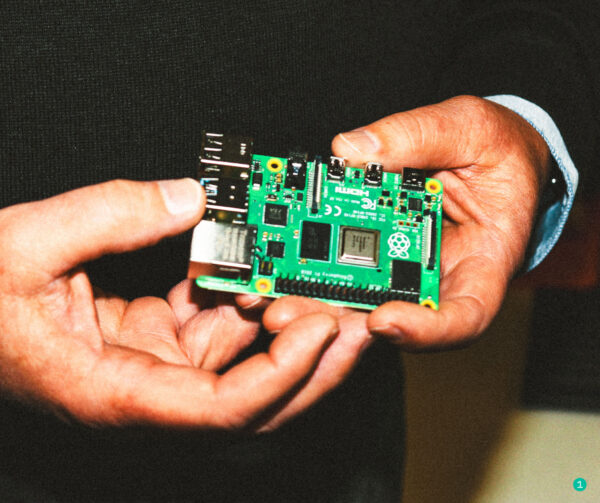
❶ Above: A single-board computer known as a Raspberry Pi powers the microscope. (PHOTO BY COLLEEN MACDONALD)
In a hospital in the Ugandan city of Mbarara, Western professor Ian Cunningham and research student Justin Yang walked through a pediatric ward lit only by daylight coming through barred windows.
Accompanied by Ugandan biomedical engineer William Wasswa, they navigated the room crowded with beds but little medical equipment. Sick children sat close to their mothers on every bed. More children huddled on the floor. As they left the ward, the sobering reality came into sharper focus.
“Dr. Wasswa told us, ‘The majority of those children are suffering from malaria. Many of them will not survive,’” Cunningham says.
Africa bears the overwhelming weight of malaria infections, with 95 per cent of the world’s cases. The mosquito-borne disease remains a leading cause of death on the continent, killing an estimated 579,000 people in Sub-Saharan Africa in 2024, according to the World Health Organization. Children under age five account for more than three quarters of these fatalities.
“The problem they’re facing is profound. Malaria is the number one cause of death in Uganda, particularly among young children—and that’s the biggest tragedy of it,” Cunningham says.
The early symptoms—fever, headache and chills—are indistinguishable from any number of other conditions. Early diagnosis is essential for starting treatment soon enough to be effective, but most malaria infections occur in rural areas where trained medical technicians are scarce. So too are the expensive optical microscopes that provide the most reliable diagnosis. Medical equipment that has been imported or donated has not proven to be a sustainable solution. Most of these devices end up in what researchers call “medical equipment graveyards”, unused due to technical incompatibility or environmental conditions they weren’t built to withstand.
“It’s a very common issue here,” says Wasswa, head of the department of biomedical sciences and engineering at Mbarara University of Science and Technology in southern Uganda. “I can find new equipment, but components might be missing or not locally available, and when it breaks down it can’t be repaired. Importing technology that works well in Canada isn’t useful without customizing for the conditions and unique needs here.”
↑
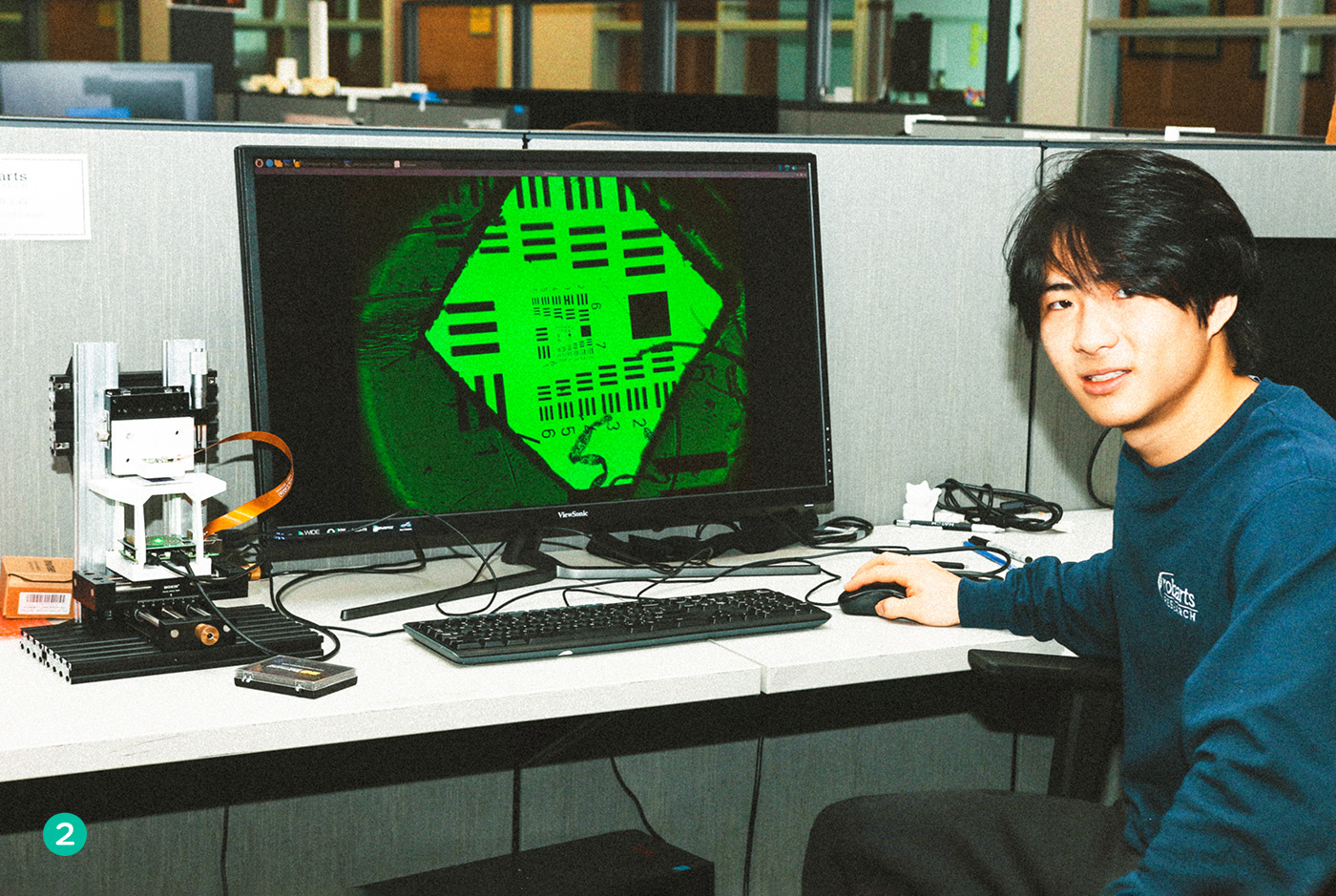
❷ Third-year medical sciences student Owen Lee, testing the image resolution of a low-cost microscope at Robarts Research Institute. (PHOTO BY COLLEEN MACDONALD)
It’s exactly the kind of problem Western’s Frugal Biomedical Innovations Program (FBIP) aims to solve. The multi-faculty initiative, led by the Faculty of Engineering, develops and deploys affordable medical devices in low-resource communities in northern Canada and Africa. The program, described as the first of its kind in Canada, addresses a stark inequity—more than half the global population has no access to essential health services, and people in low- and middle-income countries use barely a quarter of the world’s medical devices.
“These health equity failures aren’t just numbers. They lead to delayed treatment, misdiagnoses and preventable suffering and deaths,” says Margaret Mutumba, FBIP director.
“We need to fundamentally shift how we approach medical technology in global health.”
Community needs, strengths drive innovation
Established in 2022, FBIP takes a unique approach to developing medical technology.
“We are designing low-cost, high-performance medical technologies from the start, with partners who know these communities from the inside. This ensures innovations are responsive to the realities of daily life,” Mutumba says. “It’s the difference between creating technology for people and creating it with them.”
Wasswa knows well the dire need for biomedical devices specifically designed for conditions on the ground. While working towards his PhD at Mbarara University, he developed a 3D-printed microscope slide scanner that uses AI to detect cervical cancer, providing results much faster and at considerably less expense than traditional screening. His innovation soon had him considering whether similar time and cost efficiencies could be achieved in diagnosing malaria.
“I wanted to get diagnostic microscopes to people in hard-to-reach, rural areas. By the time infected people get to a health clinic with diagnostic devices, their disease can be quite advanced,” Wasswa says.
Malaria can move with devastating speed. Fatal cases lead to multi-organ failure, convulsions and acute respiratory distress as fluid fills the lungs.
In 2021, as Wasswa was exploring how to develop a low-cost optical microscope to detect malaria in blood samples, he met Ian Cunningham, a medical biophysics professor at Western’s Schulich School of Medicine & Dentistry who was volunteering in Uganda with Academics Without Borders (AWB). The two joined forces through the Canadian non-profit, which funded their initial work in devising a low-cost microscope through an AWB engineering program. “We worked very closely, meeting weekly on Zoom during the pandemic, evaluating techniques other researchers used,” Cunningham says.
Their challenge involved competing demands: designing a microscope that could be built for just a few hundred dollars yet could image the malaria parasite at a resolution of one millionth of a metre.
Their emphasis on frugal engineering within a collaborative partnership would soon make the project a perfect fit for FBIP.
Low cost, big results
More than a dozen FBIP projects are currently underway in eight countries. They range from 3D-printed prosthetic limbs to brain oxygen monitors for babies to wearable disease sensors and more, all aimed at achieving maximum effectiveness in real-world conditions—and, crucially, the ability to be used and sustained over the long term.
“All our innovations are created to be manufacturable on the ground,” Mutumba says. “If you can produce and maintain an affordable medical device in your own community, that goes a long way toward closing the global health care gap.”
FBIP focuses on three areas: shared development of technology, building equitable partnerships and training students. The low-cost microscope project reflects these core priorities and has been fostering student-led innovation from its beginning. So far, Cunningham has supervised 10 undergraduates on the project, each one advancing the design or developing the technology that will bring it to full diagnostic capability.
Cunningham’s first recruit was Justin Yang, who’d just finished his second year in medical sciences at Western. Yang was inspired by a publication from the University of Glasgow about a computational microscope using Fourier ptychography. Instead of viewing a sample through a lens like a conventional optical microscope, this technique captures a range of information from multiple angles of illumination, then reconstructs a higher-resolution image, which is displayed on a computer screen.
“The group in Glasgow managed to do this with low-cost materials, so we decided to try it for malaria diagnosis,” Yang says.
Adopting ptychography proved pivotal. Shortly afterward, Yang teamed up with two Western mechatronic engineering students, Cunningham’s son Robin Cunningham and classmate Sammy Farnum, who had tried the technology for their own low-cost microscope. The trio advanced their prototype microscope, winning multiple engineering and innovation competitions along the way.
It showed promise, but the prototype required more funding to become a diagnostic tool. In 2023, Ian Cunningham secured a Frugal Biomedical Innovations Catalyst Grant, which funds undergraduate students working full time for the summer with faculty to design safe, effective health-care solutions for settings where electricity, water or digital infrastructure may be unreliable.
“Learning to innovate within these constraints helps students to think and work beyond familiar settings and adjust their designs based on feedback from the partners and communities they’re designing for,” Mutumba ays.
‘We can solve one’
The low-cost microscope project captivated Yang, who continued working on it even after his co-creators graduated. By the summer of 2024, he joined fellow undergrads Aidan Fry, Rajan Leung, Raymond Li, Noah Park, Sarah Malik, Mohammed Mir, Brandon Pautler and Owen Lee ❷ on a shared mission to produce images with resolution unmatched by any other team.
“Watching them dive into the project was so rewarding,” Cunningham says. “They worked together really well, utterly focused on getting those first images of the malaria parasite by the end of the summer.”
Lee, then a first-year medical sciences student, helped rewrite code that runs the components of the microscope. Making these improvements to the ptychography demanded patience and persistence. “In research, sometimes things don’t go as expected and there are unanticipated delays. You discover solutions as you go,” Lee says.
↑
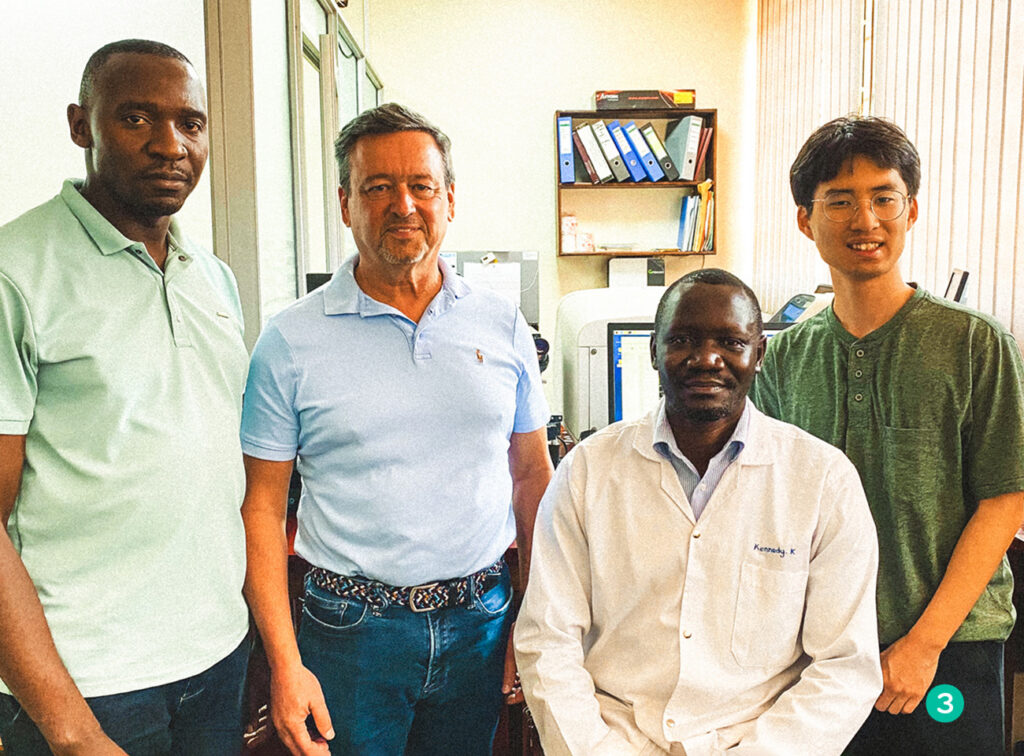
❸ From left, Mbarara University biomedical engineer William Wasswa, Schulich Medicine & Dentistry professor Ian Cunningham, Mbarara microbiologist Kennedy Kassaza and Justin Yang, BMSc’23. (Photo by Immanuel Musau Afrika)
The microscope, built with a 3D-printed body, contains a credit card-sized computer board known as a Raspberry Pi ❶, often used for DIY electronics projects. Their design offers remarkable precision for a modest cost of about $150. Yang bridged the software and hardware, and helped whittle down the processing time for generating a high-resolution image from hours to a minute.
“Every day, the image produced by the microscope was getting incrementally better, and then when we weren’t expecting it, we suddenly saw the malaria parasite,” Yang says.
Cunningham’s team became the first in the world to produce images of human malaria parasites in red blood cells using a low-cost Fourier ptychography microscope, validated against a conventional lab microscope. “When the students came to me with this, I couldn’t believe it. It was so exciting because their very first results were already working,” Cunningham says. “It felt like we could solve all the problems of the world. Of course, that’s not true, but this gives me hope that we can solve one.”
Imaging, funding progress
Last year, Yang and Cunningham travelled to Mbarara University to get feedback from Wasswa and his colleagues on their prototype microscope. ❸ Mbarara microbiologist Kennedy Kassaza confirmed the resolution was clear enough to identify the parasite that causes malaria, though the monochrome images lacked one aspect for true diagnostic quality—colour.
It wasn’t a minor detail.
Colour imaging reveals the hallmark blue rings and purple dots inside malaria-infected blood cells—an unmistakable diagnosis needed to identify and treat the disease. That confirmation is important because blanket treatment isn’t effective. Widespread, unnecessary use of anti-malarial drugs leads to anti-microbial resistance, Wasswa says.
“The drugs can become ineffective, and we’re seeing that happening now,” he says.
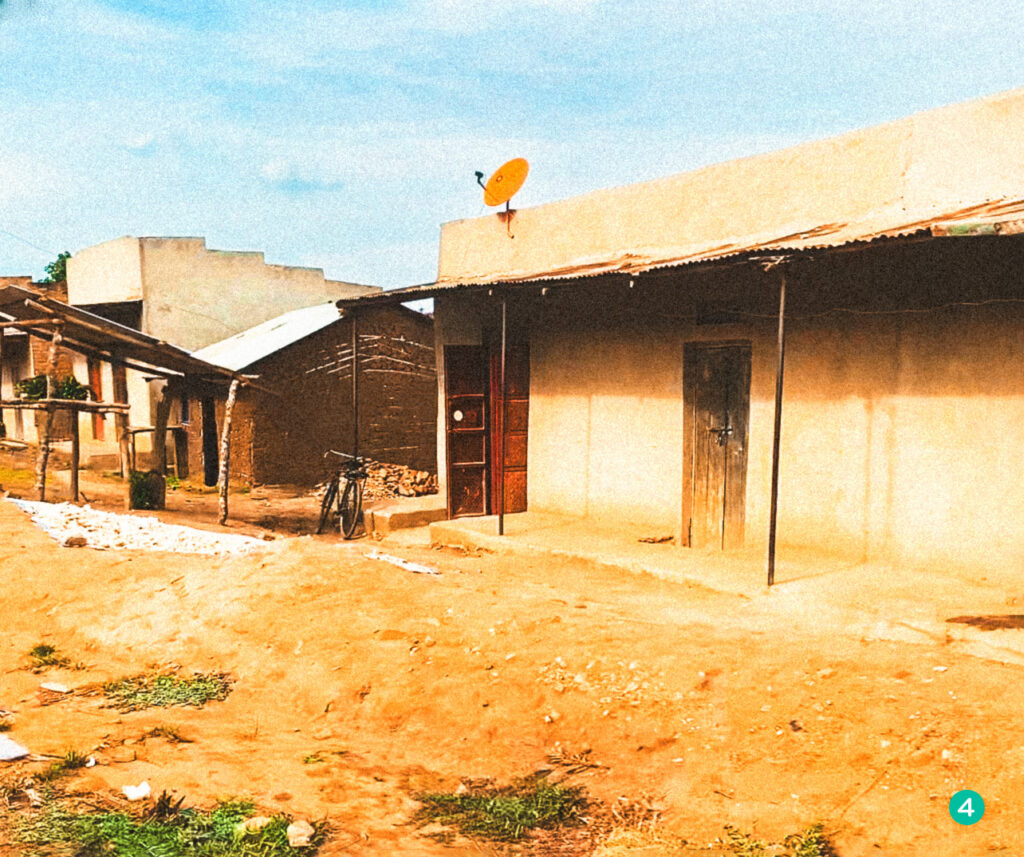
Cunningham is confident his students are getting close to colour images. Months after their paid work ended, Lee is still volunteering in that pursuit, along with Yang, who’s now studying at Schulich Medicine & Dentistry. The two are working with a new student, Hao Bai, building on the cumulative efforts of all contributors to elevate the microscope further. The goal is a dust-proof, battery-powered version tailored for rural Uganda where electricity is unreliable and dust is common. ❹ Because cell phone infrastructure in Uganda is quite strong, it will also incorporate Wi-Fi connectivity to transmit images from microscope to lab using mobile data.
Testing the innovation
Before the microscope is ready for deployment, it must be evaluated on real patients in Uganda. That step awaits funding. Cunningham says he’s in a strong position to seek it because the initial funding from FBIP generated pivotal preliminary results.
“Support from the Frugal Biomedical Innovations Program is what allowed us to show proof our concept will work. We can now make that case to granting bodies and foundations.”
FBIP projects are designed for collaboration, all the way from idea to implementation, by engaging the private sector, governments and communities alongside scientists, Mutumba says. “Beyond developing prototypes, we encourage students and researchers to think about how innovations can actually reach people and have the desired impact.”
↑
❹ The frugal microscope must withstand conditions in rural Uganda where unpaved, dry roads contribute to pervasive dust. (Photo Courtesy of Ian Cunningham)
Getting the devices to those who need them can add another layer of difficulty. The microscope will take more than engineering—it requires a business case. The Western-Mbarara team is exploring possible partnerships with companies whose employees miss work often due to malaria.
To expand access further, frugal biomedical innovations are open source. Unlike proprietary devices that are restrictive, expensive and time-consuming to deploy, open-source devices bypass such limitations. Their design, software and technical specifications are publicly available, allowing for community-driven improvements and opportunities for commercialization.
“Open-source projects get others excited about working with you,” Cunninghan says. “Our commercial opportunity isn’t in locking down the idea, it’s in building the device and setting up a pathway for images to reach a lab.”
Ugandan inspiration
For the students who’ve contributed along the way, the research has left its mark. Yang came away from his visit to Mbarara with an admiration for the resilience and creativity of people working in the most resource-constrained areas.
“When I visited Dr. Wasswa’s lab, I was really struck by how they’d developed face-shield masks during COVID, producing them at low cost and working with what they already had available to create what was needed. We can really learn from that resourcefulness,” Yang says.
Cunningham’s vision for the project is clear—passing the torch. “I want to see it in the hands of William and Kennedy, the scientists at Mbarara University. I’d love to be part of the journey, but I want them to embed this technology in their system, in their communities.” When that happens, Wasswa has his own dream for making the microscope’s diagnostics accessible to even more people. He plans to design a pen-sized microscope that incorporates AI to confirm diagnosis.
“We are very sure we can scale down the size of the microscope because its novel use of Fourier ptychography eliminates the large, moving parts of optical lab microscopes,” Wasswa says. “The future of this project is a device that allows people to screen for themselves in their own homes.”
For Wasswa and FBIP partners across Africa, North America and beyond, the work is about much more than the medical devices themselves.
“Our microscope project has the beauty of building capacity while opening new avenues for research and a viable pathway to malaria diagnosis for everyone who needs it,” Wasswa says.
And most promisingly, a future where geography is no barrier to essential health care.