Western Research Chair and cognitive neuroscientist Ingrid Johnsrude remembers seeing her father, once so engaged in world affairs, withdraw from life when he could no longer take part in conversations. A career military officer, his hearing was damaged from years flying in loud aircraft. He began wearing hearing aids in his 50s. By the time he was 70, the loss was pronounced. “It was really striking how much it affected his social life,” says Johnsrude.
She’s spent more than two decades studying how the brain makes sense of sound in the real world, especially when listening becomes difficult. “As we age, our hearing gets blurry,” Johnsrude says. “Sounds that used to be crisp and distinguishable become hard to separate.” Most of us take for granted our ability to pick a friend’s voice out of a crowded room or follow conversations in a restaurant. But these noisy settings can challenge adults with age-related hearing decline. In a landmark study, Johnsrude showed how familiar voices, those of spouses or close friends, can help people zero in on speech even in dense noise, a finding that opened new avenues for supporting communication as people age.
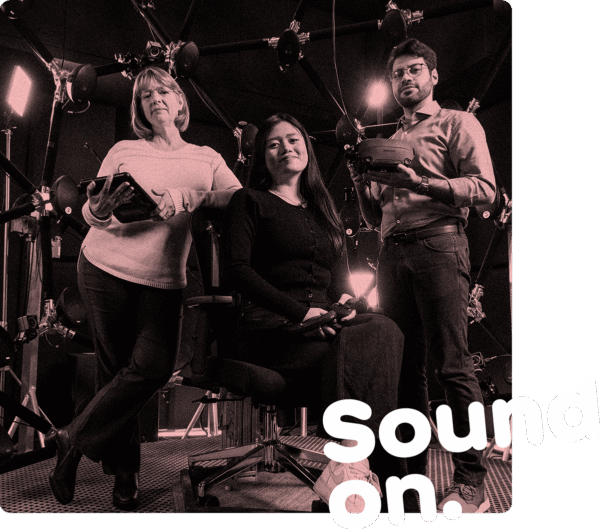
Western’s Audiodome, a geodesic structure filled with 91 speakers, allows Johnsrude’s team to place listeners in simulated environments and study how they track familiar voices against competing noise. “We’re interested in how people hear in the wild, with cars, dogs barking and other background noise,” says Johnsrude, a Distinguished University Professor and principal investigator at the National Centre for Audiology.
The system can precisely position multiple moving or static sounds in three-dimensional space, recreating how people experience noise—in coffee shops, parks or family gatherings—without losing experimental control. It’s especially timely work in an aging society, where research shows staying socially connected is vital for health and wellbeing. “As we get older, things change. But aging also brings increased knowledge and experience. We want to help mitigate sensory losses and ensure older adults continue to live happy, socially active lives.” ●