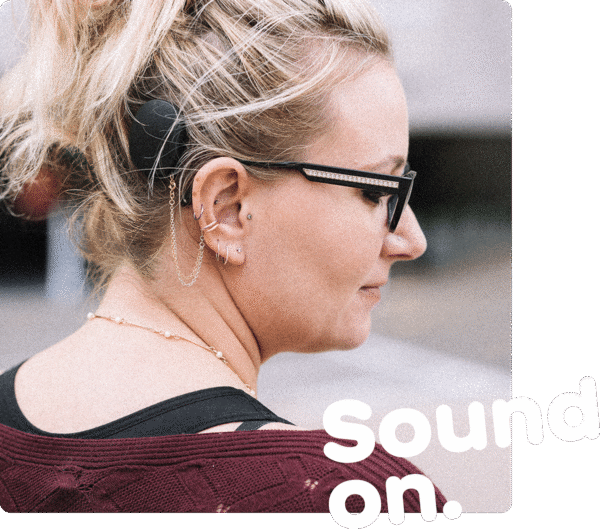
Hearing aids give millions of children access to sound. Customized earmolds are essential to connect the technology to the ear canal and hold hearing aids in place. But children outgrow their earmolds rapidly—sometimes monthly—during their first year of life. This means repeated clinic visits for silicone impressions of their ears, an uncomfortable process.
Jennifer Gould’s daughter Charlotte was diagnosed with hearing loss as a baby. The extra earmold appointments came on top of other medical visits to rule out any other underlying health issues. “The nature of the earmold process included more scheduling, waiting, poking and prodding,” says s a mother of three, Taryn Armstrong worried constantly about keeping her children safe. Living with Meniere’s disease, a disorder of the inner ear that causes progressive hearing loss, she struggled to hear passing traffic on the walk to the school bus.
Diagnosed at 24, Armstrong lost hearing in her right ear, requiring a hearing aid within four years. Two years later, as her hearing loss progressed, the device no longer helped. When hearing in her left ear began to fade, total hearing loss loomed.
“It was really scary,” says Armstrong, who feared not only everyday dangers, but missing special moments with her family.
That changed when she became the first patient to receive a cochlear implant with customized mapping through a clinical trial led by two National Centre for Audiology principal investigators—Dr. Sumit Agrawal, a neurotologist and skull base surgeon in the department of otolaryngology—head and neck surgery at Schulich Medicine & Dentistry, London Health Sciences Centre and St. Joseph’s Health Care London, and Hanif Ladak, a professor jointly appointed in the departments of medical biophysics and electrical and computer engineering.
Cochlear implants electrically stimulate the inner ear to restore hearing.
Ladak says the challenge is that in programming cochlear implants, it’s assumed everyone’s cochlea—the spiral-shaped part of the inner ear that processes sound—is the same size.
“The anatomy of the inner ear differs from patient to patient and because of this, their needs are very different,” he says. “Yet implants have historically been programmed with ‘one-size-fits-all’ settings.”
Agrawal and Ladak are changing that. Using high-resolution imaging and AI, they have developed a customized mapping tool that programs each implant to match the precise anatomy of an individual patient’s cochlea.
“It’s like tuning a piano,” Agrawal says. “Patients get a cochlear implant that can be massively out of tune by one or two octaves—they can understand speech, but music or tonal languages are difficult. By precisely tuning the implants, we’re hoping to greatly improve their sound quality and listening experience.”
In 2023, Agrawal and Ladak’s innovative work attracted $8.5 million from MED-EL, a global hearing implant company. The gift, matched by Western, created two endowed research chairs, with Agrawal named as the inaugural chair in neurotology and translational hearing innovation and Ladak as the inaugural chair in auditory biophysics and engineering.
The donation is bolstering auditory research and innovation at Western, fostering collaboration between implant developers, researchers, surgeons and patients—like Armstrong.
“This work has been life-changing,” she says. “It’s given me my confidence back.”