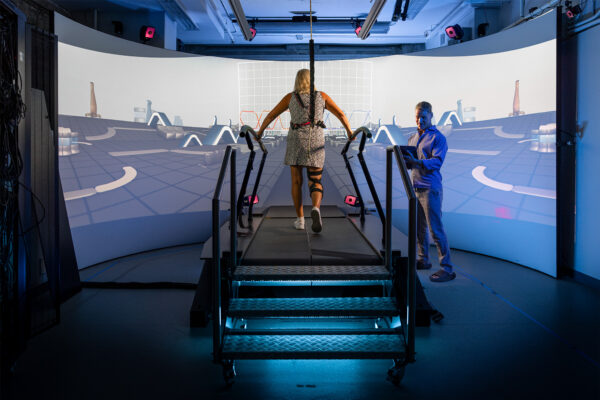
A visit to Western’s Wolf Orthopaedic Biomechanics Lab (WOBL) may make the uninitiated feel like they’ve just stepped onto the set of the next big budget Marvel movie. A patient is fitted with a few dozen precisely placed tracking markers, similar to those used in Hollywood for special effects.
Here, though, the markers aren’t turning anyone into a superhero. They serve as reference points for sophisticated motion-capture systems that track how the body moves. As the patient walks, runs, jumps, throws a baseball, swings a golf club, multiple inconspicuous cameras throughout the room capture their movements in three dimensions.
At the same time, specialized tools in the floor and on the treadmill measure forces, while electromyography sensors on muscles record which ones are firing and when. All that data can turn an ordinary walk into a remarkably detailed picture of how joints function well, and where they do not. And it’s the kind of technology that makes movement visible in ways the human eye simply cannot. Building on Western’s strengths in musculoskeletal research, including through its Bone and Joint Institute, WOBL’s team helps support lifelong mobility for thousands each year.
Started with financial support from the Bernard and Norton Wolf Family Foundation and the Canada Foundation for Innovation, WOBL (amusingly pronounced ‘wobble’) is a research partnership between Western and the Fowler Kennedy Sport Medicine Clinic. Now in its 25th year of operation, WOBL has helped train clinician researchers who have gone on to academic careers across Canada, the United States and Australia—some even establishing biomechanics labs of their own.
“What makes WOBL special is our team and its ability to use the technology in rigorous clinical research studies. We combine biomechanics, advanced imaging and biosamples with measures that matter most to patients, such as pain and function, before and after treatments,” says WOBL co-director Trevor Birmingham, a Western professor and Canada Research Chair in Musculoskeletal Rehabilitation.
This is the kind of research that makes WOBL unique. It takes something as ordinary as a walk and provides new insight into how to treat an injured joint—and, ultimately, the person attached to it.