Health is rarely far from our minds, whether our own or a loved one’s.
In my own family, I have aging parents to care for, and I think about what lies ahead for my kids. What will health care look like for them?
There’s reason to be hopeful.
Health care is on the verge of an evolutionary leap not seen in over a century.
Medical science is merging with life sciences, engineering, computational modelling and AI to bring discoveries to patients at a pace never seen before.
Called bioconvergence, it’s about bringing together the best experts with the best tools we have to find cures, develop therapies and prevent disease faster.
For all the cautions about AI—and there are sound reasons to think critically about its use—it is a revolutionary tool for advancing health care.
Take vaccine development as an example. We’re witnessing microbiology, molecular genetics and AI come together to test and deploy vaccines in record time.
Or personalized cancer therapy—customizing treatment to a patient’s genetic profile, environment and lifestyle. Then using machine learning to predict and improve treatment for others.
These are real solutions in place now, set to grow even faster and more precise in the coming decade.
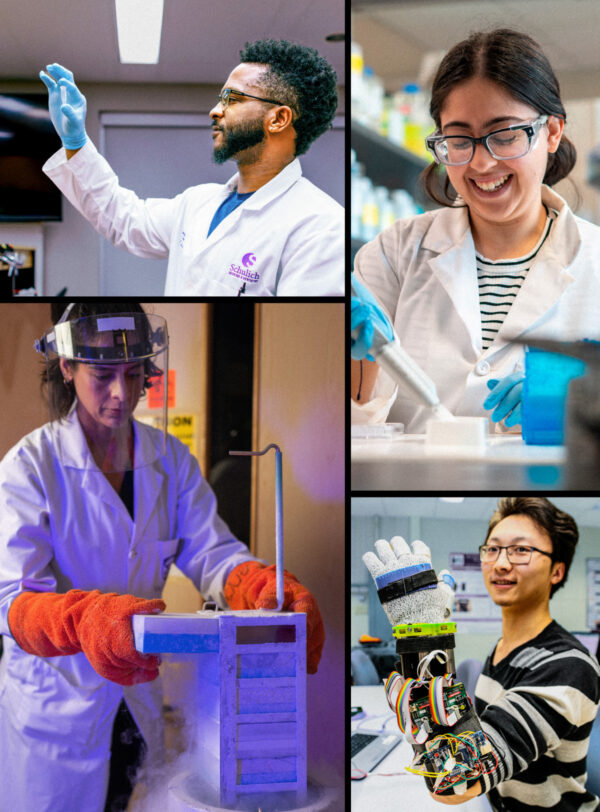
The proof is in the pages ahead. From biotherapeutics to advances in brain imaging, these stories show what’s possible when researchers, clinicians and innovators work together.
Imagine what’s next.
That’s the vision for Western’s new Bioconvergence Centre, the most ambitious project we’ve taken on in a generation. Taking shape over the next five years, it will connect leading researchers from across the Faculties of Engineering, Science, Health Sciences and the Schulich School of Medicine & Dentistry.
Industry and hospital partners will be involved from the start, helping to solve real health challenges and moving ideas to patients and the market faster.
Together with research facilities across campus and London’s health sciences ecosystem, the Bioconvergence Centre will provide us with the capacity to accelerate therapies from the lab to testing to clinical care, quickly and safely.
It will also help prepare the next generation of leaders by bringing future scientists, engineers, doctors and other health professionals together to learn and work side by side.
Working across disciplines isn’t new. It’s how Western and its London research partners have earned a global reputation in stroke and vascular care, imaging, neuroscience and musculoskeletal health, among other areas of life-changing research.
The Bioconvergence Centre builds on that legacy.
The result will be more made-in-Canada discoveries becoming made-in-Canada solutions, improving lives while creating new opportunities for growth and innovation.
That’s a future worth working toward.

Alan Shepard
President & Vice-Chancellor