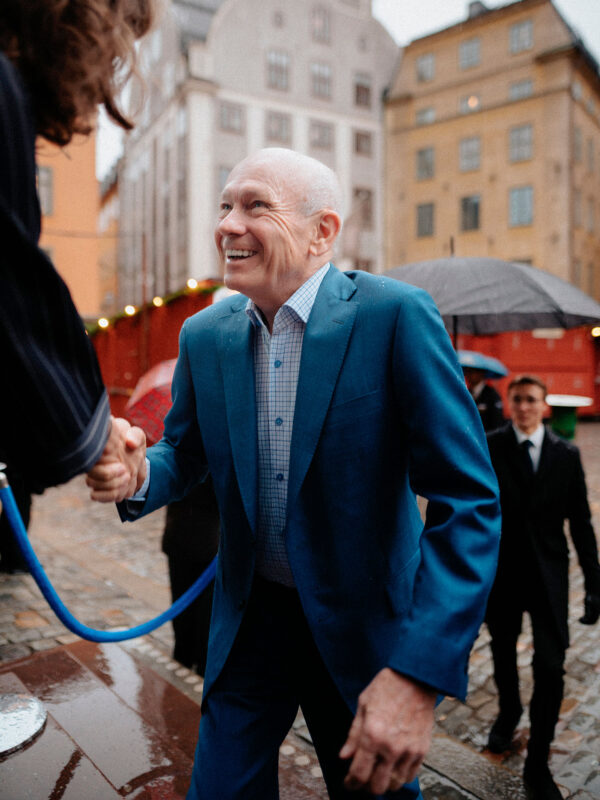
A Nobel laureate reflects on economics, artificial intelligence and launching his career at Western. The alum and long-serving Western professor called it the ‘perfect place to grow up as an economist.’
Nobel Prize-winning economist Peter Howitt, MA’69, is determined not to let the honour change him.
Though he was surprised by the win—the Western graduate and longtime economics professor didn’t even have his cellphone turned on when the first call came in—Howitt says he’s made a concerted effort to enjoy the experience while staying grounded.
He was among a trio honoured with the 2025 Nobel Prize in Economics for explaining and advancing innovation-driven economic growth. The theme is just as relevant today as it was in 1992, when Howitt and collaborator Philippe Aghion published the paper that eventually earned them both one of the world’s most prestigious awards alongside economist Joel Mokyr.
At Western, where Howitt was a faculty member for almost 25 years, he taught generations of future economists, including Tiff Macklem, MA’84, PhD’89, and Stephen Poloz, MA’79, PhD’82, LLD’19, both of whom went on to serve as governors of the Bank of Canada.
Western Alumni Magazine senior editor Megan Stacey spoke to Howitt, now retired and living in North Carolina, about the economic theory that defined his career, forces reshaping the global economy and his view on the role of higher education.
Tell me about your journey into economics. How did that interest start?
When I was in high school, I wasn’t a particularly good student, but I had a part-time job with a wool broker who imported wool from around the world and sold it to textile mills in Ontario and Quebec. He took me on as an assistant, to keep his samples tidy. I was really curious about the prices of wool, around the world, going up and down. He explained supply and demand and told me if I really wanted to learn more, I should study economics. So I did.
When I finished my undergraduate degree, I had a choice to make: I had a job offer from Dominion Textiles, one of my former boss’s clients and at that time one of the largest corporations in Canada. Or I could continue studying economics. I was accepted into the master’s program at Western and decided what I really wanted was to be an economist.
Why is the theory of creative destruction so important, enough to drive much of your career?
As a researcher, I’ve always just followed my nose. This whole idea of creative destruction really sheds light on one of the most important aspects of economics—growth itself. It’s the most vital subject we study, the process by which people’s material well-being improves. We’ve made tremendous progress. The average person today is arguably better off than the richest person 200 years ago, from longevity and health to technology.
A really important aspect of technological progress is that it benefits many, but it doesn’t benefit everyone. It can improve lives, but it can also destroy people’s livelihoods by replacing previous technologies. There’s this conflict that’s always been there, between the old and the new, that’s really at the heart of economic growth. How that conflict is resolved is critical for whether a country is going to succeed or stagnate.
When Philippe and I started talking, we realized we could incorporate this idea of creative destruction into a model economists could actually use to teach and measure things.
Do you see this theory everywhere? How do you relate to creative destruction in your everyday life?
As a professor who was really interested in doing research and generating new ideas, I realized there’s a lot of creative destruction in academic research as well. New ideas render old ideas obsolete. It’s one of the things that encouraged me to retire. I’m stepping out of the way of other people’s new ideas.
How should we handle rapid change, when it feels like new technologies are moving at such an extreme pace?
There’s no way to stop it. I’m not so sure about what artificial intelligence is going to bring. But you have to take heart in the fact that when a new general-purpose technology like AI comes around, it isn’t the first. We’ve had the steam engine, electrification, the IT revolution of the 20th century. What’s most apparent at first is how new technology has the potential to destroy jobs, but it always turns out to have an even bigger potential to make jobs more productive. Some people’s jobs will indeed be destroyed by AI. I think, as a society, we have an obligation to try to help people with this transition, not just by providing income, but also helping to retrain. A cooperative effort between government, business and universities is needed.
What role should universities play in that trifecta, especially as higher education seems to be under threat?
Universities will always be valuable. It’s that interaction between scientific curiosity and technological progress that makes the combination of businesses and academics so productive. It needs to be coordinated and financed, and the government has a role in doing that. From the first computer to groundbreaking agricultural advances, that tripartite cooperation has led to some of the biggest technological advances in modern history, and I think that’s likely to be so in the future.
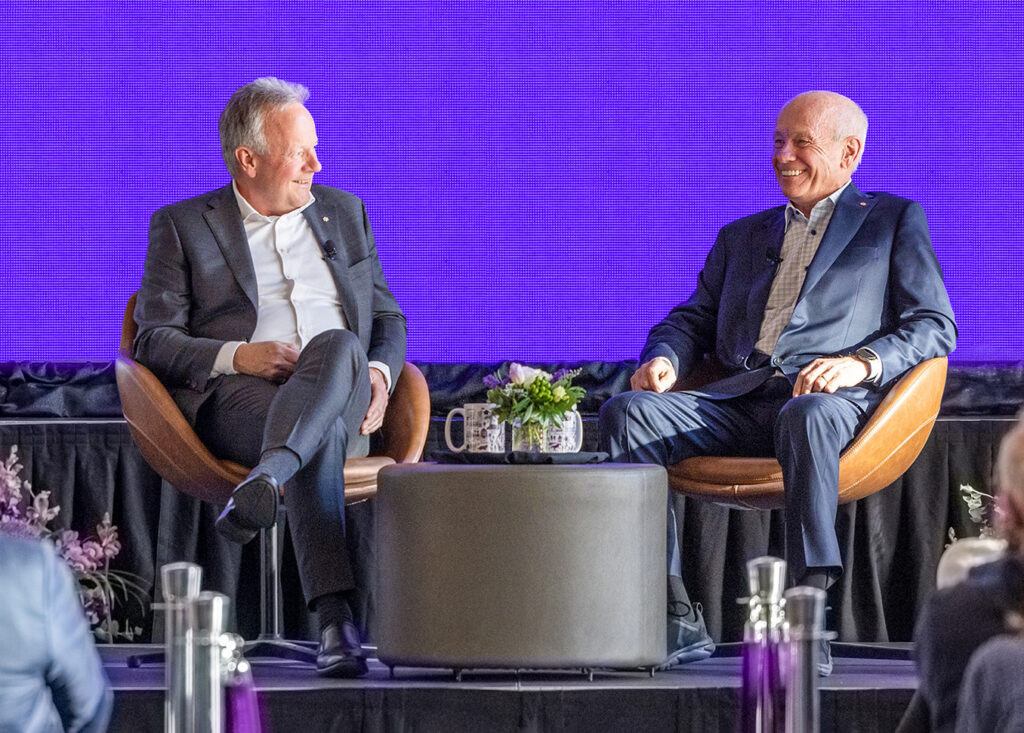
What drew you to Western? Tell me about your time here.
I knew getting a master’s degree from Western would be to my advantage. After I earned my master’s, I went to Northwestern to get my PhD, but I came back to Western as a professor just three years later, when the economics department was expanding very rapidly. It was full of young people with a tremendous interest in doing research—if they didn’t, they knew this wasn’t the place for them. It was a lively atmosphere dominated by people very excited by what they were doing. It was just the perfect place to grow up as an economist.
Shortly after I arrived, we hired two superstar macroeconomists who would become mentors and colleagues, David Laidler and Michael Parkin. They were full of infectious energy. David and Michael gave me and other young macroeconomists at Western a lot of encouragement, as well as very stern criticism when we didn’t measure up to their high standards. I owe them a lot.
Are there any memories from your time as a graduate student or professor that stand out?
I have very happy memories of being at Western. I spent a lot of time in Weldon Library, finding copies of the latest economics journals. I would rummage through the stacks, looking for various books and reading. But most of my time was spent in the Social Science Centre. I especially loved teaching the honours economics students. They were very smart and very curious, and I learned a lot from them.
You now live in the U.S., but I’m curious about your thoughts on the Canadian economy.
I think Canada is doing very well, trying to react to the new global trade environment in the most sensible way possible. Economic growth is very dependent, especially in a relatively small country like Canada, on open international trade; it’s important to keep that going, even when your major trading partner is putting up barriers.
How do you see this next chapter unfolding?
When you win a Nobel Prize, you suddenly hear from people all over the world. There are all sorts of opportunities opening up, and there are parts of the world my wife and I would love to see. But we had a very happy life here in the hills of North Carolina—enjoying nature, hiking and playing golf—before I got this prize. I’ve been contacted by other Nobel laureates who kindly got in touch, not just to congratulate me but to offer advice. They all tell me this is a big dividing point in their lives. They had a life before and after the prize, and in many cases, they don’t have a lot to do with each other. I enjoy my life here; I don’t want to make a huge change.
I have to pinch myself, not just to realize this is actually happening, but to make sure I don’t get too carried away. You could just sit back and bask in all of this. But I still get up in the morning, I still put my pants on one leg at a time. It’s still me.