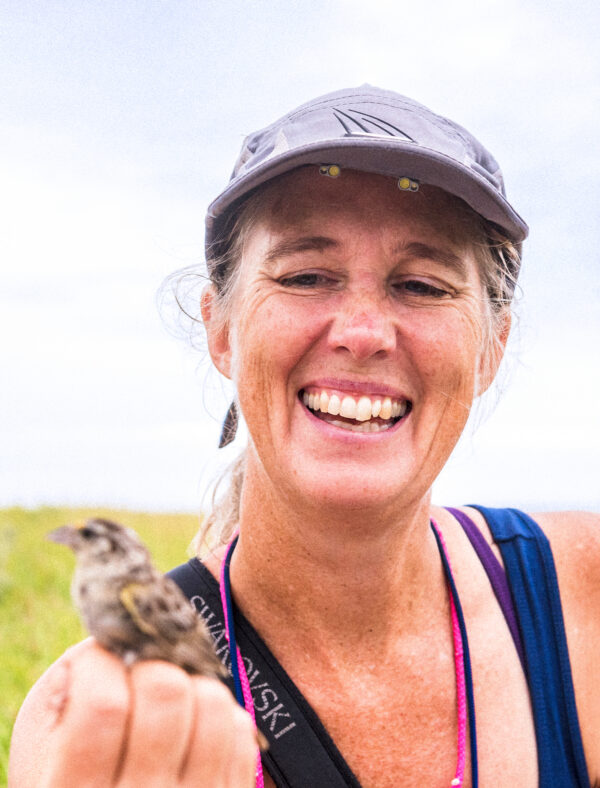
Alice Boyle (pictured above) is a Western biology professor and member of the Centre for Animals on the Move and Advanced Facility for Avian Research. Boyle and her team investigate “fundamental ecological questions” about birds and why some of them are in trouble.
Music was her first love. Alice Boyle grew up in Winnipeg, in a home full of instruments—there was never any question that she, too, would play one. After her parents nixed the first pick—tuba—she tried her hand at piano and discovered she really didn’t like it enough to practice. Then she chose viola.
It led Boyle to a bachelor of music from the University of British Columbia and later to the National Symphony Orchestra of Costa Rica, her first job after earning her degree. But in the tropics, she got hooked on a new passion as she adventured, exploring the plants and animals of Central and South America.
She’d received a pair of binoculars and a book on birds as a graduation present. It sparked a lifelong joy that would reshape her trajectory and eventually bring her back to Canada to join Western’s Centre for Animals on the Move.
Boyle had always loved wildlife, but surrounded by Costa Rica’s rich biodiversity, there were endless new possibilities to learn and enjoy nature.
“Every day off, I’d get on a bus and go to a new place to look at birds,” she says. “All the rocks were covered with plants and animals. I ended up becoming an avid natural history buff, not just birds, but plants and butterflies as well.”
Boyle’s home became a hotspot for researchers heading into the field because of her partner’s work as a biologist. She often joined, helping teams with their projects.
Her career—and life—has been defined by two pivotal moments. The first came when she left the orchestra. “I decided I wasn’t going to be a professional musician anymore. I was going to do something else.”
But she didn’t know yet where she’d end up. Boyle took a job as a field tech, because she had the skills and loved being outside. She studied songbirds and seabirds like the Marbled Murrelet and took months-long birding and snorkeling trips in her antique VW van.
Eventually, Boyle found herself internally critiquing the methods and approaches used in the field. She could see a better way. “I decided I didn’t want to be someone else’s tech forever.”
Grad school was the next stop—the second pivotal moment. It took intense studying and the biology GRE— a standardized test used for many graduate school admissions—before she could pursue her new path.
Boyle still didn’t think she’d end up in academia. She figured she might run a field station. But she fell in love with the pursuit of scientific knowledge.
“I found that I really liked research. I loved finding the answers,” Boyle says. “This is one of the joys of being an academic; you get to discover things that need finding out.”
Her PhD was followed by two postdoctoral positions, including one at Western, investigating why birds behave certain ways in the wild, especially during migration or when faced with changes in rainfall amid climate change. She spent 13 years at Kansas State University, becoming recognized across the field for her work in bird movement ecology and population dynamics.
The Boyle Lab studies birds in the wet forests of Costa Rica and grassland species in the North American prairies, like the Grasshopper Sparrow.
In 2025, Boyle left Kansas State to return to Western and join the Centre for Animals on the Move, led by her former postdoctoral supervisor, Chris Guglielmo. “One of the biggest things that excited me about this job is that Western has an absolutely incredible community of people studying animal movements and birds. I can go down the hallway to talk science with people who care about the same topics I do and have great ideas to share,” Boyle says. “The Centre for Animals on the Move is a major draw for me. It’s four years in and getting better all the time. I really look forward to helping it grow.”
The love of research that inspired her academic career still drives Boyle, now the Canada Research Chair in Global Animal Movement Ecology. “What keeps me going is the very direct relationship between the effort I put in and potential change. I try to do at least part of my work in areas where there’s a direct conservation application,” she says.
And though she pursued science, Boyle didn’t leave music behind. She still plays frequently, mostly fiddling, providing entertainment at dances and Irish halls, including the odd on-campus performance, at spots like The Grad Club.
“It’s the best possible antidote for science. It gives my brain a total break—you have to use it all to be able to play,” Boyle says. “It’s a great de-stressor and gives me such pleasure.”
Her musical passion also makes her a better scientist, Boyle says. From the lessons she learned performing, to the perseverance and drive it took to make it as a musician, her background continues to pay dividends.
“Music creates new neural pathways in different parts of your brain—that allows me to see things differently and fuels the creative processes that are very much a part of science. Coming up with new ideas and new explanations and new ways to do things, that’s all very much a creative process.”