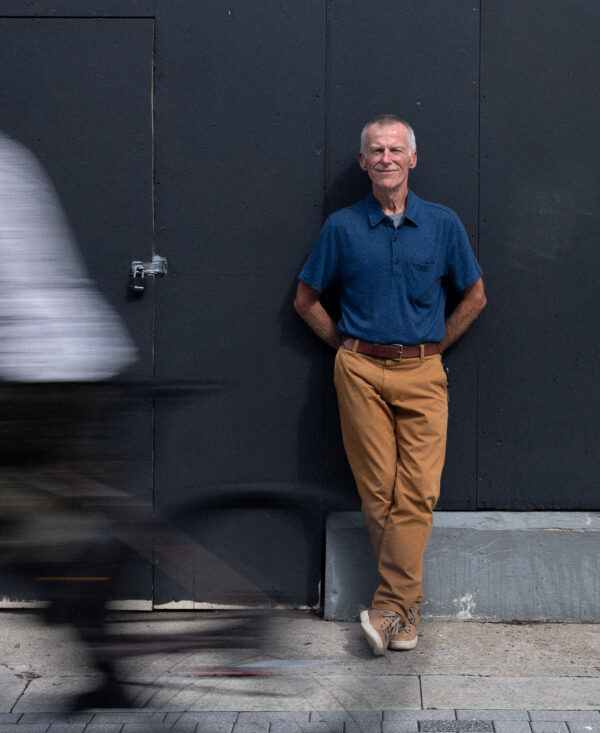
When Steve Cordes, BA’84, retired in 2025 from Youth Opportunities Unlimited, known as ‘YOU’, he had spent more than four decades helping young people find their way. He started fresh out of university as a new graduate and worked his way to CEO, spending 37 years at the helm. As the homelessness crisis in London, Ont., deepened, Cordes kept the focus on the difference his team was making, connecting youth with everything from employment skills to housing to mental health supports. Here, he reflects on his career and what it takes to tackle homelessness.
In May 1984, I walked into a small, hectic youthserving agency, still in its infancy. I had just graduated with a sociology degree from Western, and a friend told me Youth Opportunities Unlimited (YOU) was hiring. Unemployment was high and I was determined to stay in my hometown of London.
I was greeted by a space that was crowded, chaotic and “gritty.” Yet it drew me in. I remember three youth waiting—one was having a psychotic episode, another experiencing homelessness and the third was seeking work. They were warmly greeted by staff and connected with supports. That memory was a reference point for me as YOU grew—and tackled significant challenges—to ensure its authenticity and warmth remained.
YOU often took chances on young people, and it was no different with me. I was offered a role as their first job developer simply because I seemed to have a good attitude and had stopped in three times a week for two months until they finally interviewed me.
As I climbed the ladder at YOU, eventually becoming CEO, London was grappling with a crisis common across Canada—homelessness.
Though we also worked on broader policy and preventon issues, I always kept the focus on the difference we could make locally, celebrating our wins one by one. To keep a sense of hope, the focus had to stay on the people and the issues we could impact in our community.
YOU grew from 12 employees to 120 during my time there. Our budget expanded by more than 1,000 per cent, and by the time I retired in 2025, we were serving 2,000 youth every year. It wasn’t the growth I cared about most, it was whether young people walking through our doors still felt the same sense of support I witnessed on my first day there.
I was CEO for almost four decades. Anyone in the lead role so long runs the risk of losing touch, but I was determined to stay real and check my own assumptions. I made time each day to chat with young people—casually at reception, in the hallways or out front of our building. I’ll never forget stopping to pet a young woman’s dog outside our first major youth housing development, the Cornerstone Building, on Richmond Street. She told me the day she found out YOU had an apartment for her was the same day she had planned to die.
“Without that, I wouldn’t be here. My dog wouldn’t have a home,” she told me.
We always concentrated on what each person needed. If today it’s just keeping them clean and dry and providing a place to sleep, that’s what we’d do. But we didn’t stop there. We kept them moving forward and helped put a plan together.
To help community leaders understand our work and hear from the youth we served, I led the creation of Breakfast for YOU, our signature event anchored by keynote addresses from youth, parents and supporters. Their powerful and personal stories helped provide a deeper understanding of homelessness, human trafficking, issues affecting transgender people and how a community can work together to support youth. You can read about trafficking in the news, but when you hear from someone who thought she was attending a party and instead was sold by a friend to a stranger in a hotel, you understand it in a much more real way. Years later, the event has helped raise millions for youth.
One of my greatest dreams was to build a culture where the community felt YOU’s success was their success. I wanted people to connect to the faces behind the statistics and feel invested in helping youth who are so disenfranchised. We can’t accept homelessness as a reality for anybody.
Through YOU, we made a real impact. I remember a donor handing me a six-figure donation through tears. I didn’t even know the person six months before; but they had a child who was struggling, someone they couldn’t reach.
At YOU, we stuck to our vision and our values and always prioritized changing the life of one person at a time—each youth who walked through the door deserved that chance.
The last email I received before logging off for the final time at YOU was from a young person who thanked me for taking the “just” out of being “just a youth.” She said I made her feel seen, heard and valued. More than a year into retirement, those words still mean everything.