
The youth mental health crisis is not letting up, and neither is the demand for help.
A recent Statistics Canada study found rates of fair or poor mental health among youth more than doubled from 2019 to 2023.
It comes as no surprise to Colin King, a school and child clinical psychologist and director of Western’s Mary J. Wright Child and Youth Development Clinic. He’s seen a significant rise in mental health challenges and learning gaps among children and youth since the COVID-19 pandemic. Families are also facing what King calls “a multitude of pressure points.”
“Nothing breeds anxiety and stress like uncertainty, whether it’s climate change, geopolitical issues, rising living costs, AI or the world your child will inherit. We all feel the weight of it,” he says.
The clinic was founded by the late Mary J. Wright, BA’39, LLD’82, a trailblazing academic. In 1960, at Western, she became the first woman in Canada to chair a major psychology department, before serving as the first woman director, then president, of the Canadian Psychological Association. Yet Wright’s proudest accomplishment came in 1973, when she opened a university preschool for low-income families—a project she’d later call “the crowning achievement” of her career.
Wright envisioned the school not only as a support for families, but also as a child development research hub where psychology students could gain hands-on experience.
Today, the clinic helps to set children and families up for success by providing a suite of services, ranging from early intervention to more intensive and individualized support.
“Sometimes families don’t know what they need—they just know they’re struggling. We can give them a roadmap for where we may be going together,” says King, BA’03, a professor in the Faculty of Education.
Since 2017, King and a team of graduate students in the school and applied child psychology program have supported more than 1,800 families in London, Ont., and surrounding area. Under the supervision of licensed psychologists, the students consult on cases, helping assess kids and suggest treatment options.
In practice, graduate student clinicians work with children and parents, gathering information and offering strategies. With about 200 families served each year, many of the clinic’s services have relatively short wait lists compared to community services.
That’s a big win.
The clinic also offers a variety of intervention options, from individual evidence-based reading support to group-based programming for anxiety and emotion regulation to one-on-one meetings with families. A student may coach a child with selective mutism through small, gradual steps toward speaking in class or share strategies with a family trying to tackle tricky behaviours at home.
Accessing psychologists through the public system can be difficult, as many are are focused on intensive or specialized care. In private practice, fees can exceed $250 an hour. Services at the Mary J. Wright Clinic, however, are provided at reduced cost and can be further lowered based on family income. Fifty per cent of the clinic’s clients are subsidized through a special accessibility fund, supported by donors.
With lower fees and shorter wait times, the clinic provides more accessible, timely care.
Partnerships with local agencies and health-care providers are critical. “What really sets us apart is how integrated we are with the community,” says King. “We’re part of the health-care ecosystem, not something separate. If we really want to move the needle on mental health, we need all our structures and supports working together to support children and youth.”
The clinic works with London Health Sciences Centre (LHSC), Vanier Children’s Mental Wellness, London Family Court Clinic, Navigating Onward, Thames Valley Children’s Centre and local school boards, partnerships that are foundational to its model of care.
“I think there’s a misconception that you come to a psychologist expecting a traditional expert-delivery model and you’ll receive answers,” King says. “The reality is much more collaborative. We bring expert psychological knowledge, but parents are the experts on their child and their experience. We partner to figure out the path forward together.”
The clinic extends its reach by offering resources to the broader community through group sessions and workshops, led by King and psychology graduate student clinicians. Past offerings include Get it Done group coaching programs to help teens develop skills and work habits for school success, and Parent-led Strategies for Child Anxiety workshops. Online sessions allow the clinic to reach up to 300 people at once. Working closely with children, families and community partners informs King’s applied research lab, adapting mental health interventions to provide earlier support for children and families.
“We’re fortunate to have the clinic as a living laboratory, where we hear directly from families and kids about their realities,” King says. “It helps us understand their lived experiences and informs evidence-based care. We can also learn about the gaps and opportunities in a deeper way, enabling us to design appropriate, responsive services.”
Without support, families might misinterpret what’s really going on. King says parents often assume a child’s struggle is about will, when it really reflects an undeveloped skill. “It gets ascribed to personality or effort—they don’t want to be cooperative, they’re not motivated,” King says.
Kids can internalize challenges, he adds. Rather than recognizing the unique stressor or experience they are going through, such as an anxiety disorder, they may start to think, “It’s about me. I can’t do this. What’s the point?” Left unaddressed, these misunderstandings compound. “There are a lot of missed opportunities around the explanations and narratives a young person may build in their mind when we don’t understand what’s really going on,” he says.
Those insights—and the sharp uptick in community needs—drove King’s team to help build mental health literacy through their Storybook Project. It involved reviewing hundreds of children’s books to identify those addressing specific anxieties, from generalized worry and social anxiety to dealing with separation anxiety in new situations, such as the first day of school.
“We’re bringing together clinical evidence and stories that provide words and context for what children are experiencing. Parents and caregivers can use the stories to start conversations and respond to anxiety,” King says.
There are about 200 books on their curated list, which is part of a free resource guide, Supporting Knowledge & Skills in Managing Anxiety Using Storybooks. The guide has been downloaded more than 2,000 times, with hundreds of physical copies distributed to families at the clinic and through partnering organizations. “This is one of the ways we can empower kids and families with the tools to move forward. Kids learn they are much stronger and more resilient than they believed. These early lessons can change their life trajectory,” King says.
Among the more than 90 graduate students the Mary J. Wright Clinic has trained since it opened, many have gone on to leadership and clinical roles at mental health agencies, school boards, hospitals, clinics and private practices. Besides training students from Western’s school and applied child psychology program, the clinic helps shape the next generation of psychologists from across Canada, serving as a supervised residency training site where doctoral candidates gain the hands-on experience required for professional practice.
That includes psychologist Micah Tilley, who now runs a private practice in Conception Bay South, N.L. From the moment she arrived at the clinic and throughout her residency, Tilley says she was inspired by its culture and model of care. “Everyone was so warm, and the whole-family approach made a lasting impression on me. It wasn’t about bringing a child in to be ‘fixed.’ It was about supporting parents, reducing stress and helping families thrive together. That approach was something I wanted to bring home.”
Tilley also saw results.
“I remember a parent coming in with her preschool child, who had some very big emotions. She was finding it hard to help him manage his feelings and deal with the stress that comes with it.” With support from the clinic and through practising the strategies at home, Tilley saw a noticeable shift in the parent and child.
This process felt really collaborative from the beginning. I knew my child would not participate in traditional therapy, but receiving support directly as a parent has been a great decision for us. Things are going much better now and the knowledge I received was a key part of us doing things differently as parents.
— Parent participant
Grishma Dabas recently completed her residency at the clinic as part of her doctoral studies in clinical psychology at Lakehead University. Part of her work included conducting assessments and interventions with clients, including those in partnership with developmental pediatricians at LHSC. “The clinic does a great job of meeting people where they’re at,” Dabas says. “That means making services available to families who couldn’t otherwise afford them and adapting assessments and interventions to meet each client’s needs. Families know their opinions and perspectives matter.”
Dabas says it’s a lesson she reflected on throughout her residency and one she’s applying as a clinical psychologist at Dilico Anishinabek Family Care in Thunder Bay, Ont. “As psychologists, it’s important to be client-centred, taking their preferences, cultural values and diversity into account. I saw that play out in a deeply thoughtful way at the Mary J. Wright Clinic. It’s something I definitely carry forward when I consider clients’ needs during assessments and interventions.”
Dabas’ takeaways would no doubt hearten Wright, whose research showed how training educators and future psychologists in evidence-based child development can fundamentally improve lives and outcomes for children.
As King looks to the future, he hopes community support will help the clinic grow its team of supervising psychologists, creating more training opportunities for students while helping more children and families access care.
“Suffering ceases to be suffering when there’s meaning,” King says. “Being able to give families a framework for what’s happening in those tough moments, to have that experience validated and then see the light bulbs turn on for parents and kids—that’s the impact.”
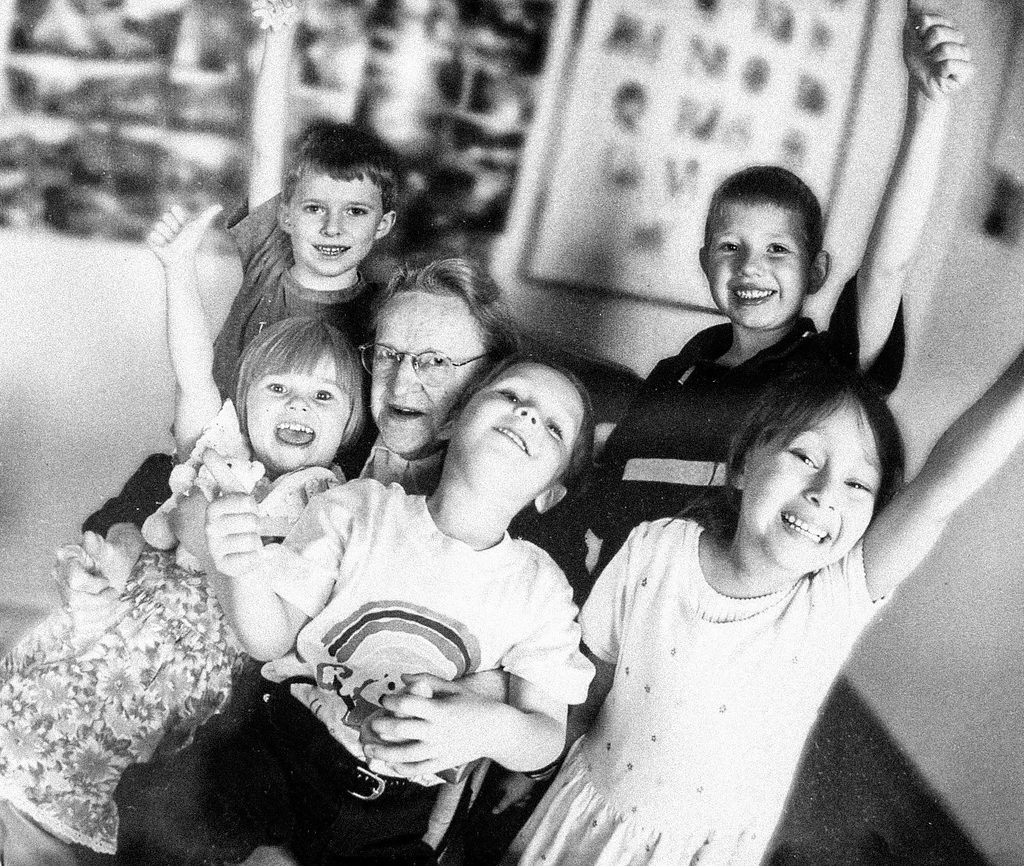
Mary J. Wright in 2011, surrounded by children, decades after her dream to open a family support centre and child development research hub came to fruition. Photo by Shawn Simpson