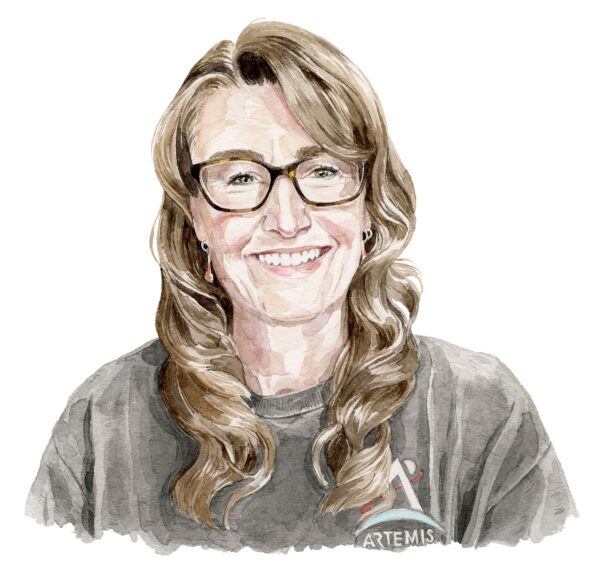
From a rural Alberta hospital where she was the only OB/GYN—on call 24 hours a day—to her journey supporting women in midlife, Dr. Catherine Hansen, MD’96, has brought her signature style and a comprehensive approach to health that goes beyond the physical.
Her medical career has taken her across continents, serving diverse populations and patients in many stages of life, while her personal life has captivated audiences all over the world. Earlier this year, Hansen watched her husband Jeremy make history as he rocketed off the planet on NASA’s Artemis II mission, becoming the first Canadian astronaut to travel to the Moon.
Amid hectic travel days as the family moved back to Canada following Jeremy’s transition to military reservist and space advisor, Hansen spoke with Western Alumni Magazine, sharing insights on the iconic mission to the Moon, medicine for midlife women and her family’s approach to maintaining health in the most chaotic chapters of life.
You and your family are busier than ever these days. Tell us what it’s like to come back to Canada, after years in the U.S. while Jeremy worked with NASA.
Canada never stopped feeling like home for us. During our 17 years in Texas, we continued travelling and exploring Canada as a family. Just after the pandemic, we decided to purchase a lakeside property we could use as a home base near Ottawa when Jeremy was needed at the Canadian Space Agency or attending military or government meetings.
We have made this our permanent home, and while we are still living out of boxes and will be for a long time, we find profound peace watching the Moon rise and set from our dock.
Women’s health has long been a passion of yours, and now your focus is on women navigating midlife and menopause. What drives you?
For too long, women have been expected to sustain families, workplaces, communities and institutions while navigating profound physical, hormonal, emotional and professional demands—often with inadequate support. True women’s health is not simply about addressing symptoms or preventing illness. It is about ensuring women have the knowledge, resources and permission to be well. That’s not just being physically healthy, but emotionally grounded, professionally fulfilled and able to thrive in every dimension of their lives.
This matters to us all—or it should. When women are depleted and overwhelmed, the effects ripple through homes, organizations and communities.
My hope is that women’s health becomes recognized as an essential investment in global progress—not a niche concern or an afterthought. Supporting women helps create a healthier, more capable world.
Why is that work so important to you?
What I’ve noticed, working in the U.S. and Canada, is that people will, unfortunately, prey on that vulnerable population. When women are most confused and uncertain, people come in with solutions that are not evidence-based or credible and often overpriced.
Women are really seeking and searching for answers and getting misinformation.
For me, that’s been an impetus to share more evidence-based medicine as well as wellness strategies and a holistic approach to the whole woman. My life’s work is to lean into ensuring midlife women have proper care. At a time when they need to be feeling their best, they’re often feeling their worst. Being able to impact a woman at that stage of her life will ultimately have a massive ripple effect into the world.
How did you know you wanted to specialize in women’s health?
In Grade 6 I started to learn about the female body, with all its beauty and complexity, and I knew, immediately, I wanted to spend my life learning more. I was a competitive synchronized swimmer—I’ve never met a sport or physical activity I didn’t love—so I decided to undertake a bachelor’s degree in physical education, now known as kinesiology. My favourite topics were exercise physiology and anatomy. I became an anatomy teaching assistant for the last three years of my program, and it ignited my passion for teaching. I remember a lengthy conversation with my mother discussing a career as a teacher or physician and she suggested becoming a doctor who teaches—that seemed perfect!
You’re a proud Schulich Medicine & Dentistry grad. What stands out from your time at Western?
This is our 30th anniversary, which is hard to believe. We had an absolutely exceptional class and I still have friends from those years. I have incredible memories of the people who supported me along the way at Western, both my medical school classmates and the professors. Some of my greatest memories are the evenings we socialized with faculty; I remember always feeling like an important part of the physician community, even though we were students.
Over the years, I’ve continued my education at several institutions, met countless professionals and taught the next generation of medical students. One thing stands out for me—the education I received at Western is world-class. When Jeremy and I were guiding our children toward post-secondary education, we emphasized the high-quality education of Canadian universities and, turns out, they all chose to return to Canada to pursue higher learning.
Where did you go after Western?
I went back to my hometown to do my OB/GYN residency at McMaster. In my third year, feeling burnt out, I needed to find a deeper sense of purpose in the work I was doing day and night on labour and delivery, in the emergency room and operating room. I travelled with a mentor, Dr. Jean Chamberlain, who’s also a proud Western alum, to Zimbabwe. In that rural hospital, meeting people, experiencing a simpler life and learning about what’s really important for happiness, I reignited my passion. I was awakened to the knowledge that I could use my education, compassion and skillsets to help people thousands of miles away from my home.
That global experience led to a desire to learn more about underserved populations and expand my knowledge of international women’s health, so I completed a master of public health at Johns Hopkins. During that degree program, Jeremy and I moved to Cold Lake, Alta., home to one of Canada’s fighter bases.
We had our son and twin daughters—three children in under 18 months—while Jeremy travelled as a fighter pilot for the Royal Canadian Air Force and I covered call for the hospital. As the only OB/GYN, I was on call 24/7 for complicated deliveries and emergent surgeries. Resources were limited and Edmonton was our closest tertiary care centre to transfer any patients we were unequipped to manage—including premature or high-risk deliveries. Once I had to transport extra blood on a bus from Edmonton to Cold Lake to ensure I could operate on a patient who may have needed a blood transfusion during surgery.
When Jeremy was recruited to the astronaut corps, we came down to Houston. I spent 10 years as an assistant clinical professor at the University of Texas Medical Branch, where I put all of my academic work from Western to good use.
You and your children were able to watch the launch of the Artemis II mission together last spring. What was it like?
It is hard to describe, knowing that person is going so far away when it’s only a 10-day mission. It’s kind of like a long business trip, but 400,000 kilometres. Although it felt quick, it’s been decades in the making. Jeremy has been working and training at NASA for 17 years.
Becoming the first Canadian to fly around the Moon, to go farther than humans have gone, it really has been a long work in progress with many ups and downs along the way. Watching him launch in that rocket, exactly on schedule, after two previous launch windows had slipped, was a complete shock—I think even to the people who knew what was happening that day. They were expecting it to be called off or delayed at any moment. But the engines lit and it started lift off. It was a very terrifying, but also extremely exciting and joy-filled moment to know that he was realizing the culmination of those many years of work and all of his childhood dreams.
Those decades of work, leading to that huge moment—what has this experience meant to your family?
There are hundreds of thousands of people who have touched this mission directly and indirectly. The hope and dream has always been that everyone sees a part of themselves in this and knows they too can accomplish big things.
It makes me, and our grown children, feel exceptionally proud, but we also feel a level of responsibility for sharing the inspiration and motivation of this mission and the people who have contributed to the science, technology, engineering and the artistry involved. We feel part of something that we hope will continue to inspire the nation and the world.
What was going through your mind during the splashdown, the moments the Artemis II crew came back to Earth?
That was the scariest day of my life.
The end of the mission would ultimately mean we got Jeremy back safely; that was never a given throughout all of this. The splashdown was the final moment—after they had launched successfully and inspired the world—so it was very, very emotional for me. I was just praying they would come out of those six minutes of loss of signal, that we would hear them again, the vehicle would be intact, the chutes would fill and they would splash down in the ocean as planned.
Tell us what it’s like to chart another new course, with Jeremy retiring from NASA and your family making such a big change in your location and priorities.
Jeremy’s transition is not a retreat from service or Canada’s space future—it is a purposeful next chapter. After an extraordinary career, culminating in the privilege of flying around the Moon on Artemis II, he has moved into the Royal Canadian Air Force Reserves while pursuing new opportunities. This gives him the flexibility to continue contributing to the important decisions and partnerships that will shape Canada’s role in space and beyond.
What inspires us both is that space innovation is never only about space. The technologies, systems and collaborations developed for human spaceflight can help address challenges on Earth—from supporting remote and northern communities to strengthening communications, food sustainability, environmental stewardship and access to health care across our vast country. In different but deeply aligned ways, Jeremy and I are committed to advancing innovation in service of Canadian pursuits and human flourishing.
How do you approach sharing so much of your life publicly, including on social media?
I do think it’s so important for people to be able to see themselves represented.
As we show up with our whole humanity and allow people to see who we are—and that the wholeness of who we are isn’t perfect; we make mistakes—I hope it makes people feel more included. It disrupts isolation and helps people realize they only need to show up as themselves.
In our family, you wake up in the morning and your only goal is to contribute your best, to use your skills for good—because you have them for a reason—and find the joy in it.
You and Jeremy both live such busy lives. How do you actually put that into practice?
We have to remind each other the goal is joy and through contributing our gifts, we find that joy.
One of our daily practices we’ve implemented over the last several years as life has gotten so crazy busy, is morning coffee time. We do it virtually if we happen to be apart, and we’ll do other things together, including meditation. It’s that special time when we have that face-to-face connection and set our intentions for the day.
I don’t want to overstate and suggest we have joy all the time. That’s not true. But that is the ultimate place we aim for. As Jeremy says, when we get off the joy train, we try to get back on as soon as we can—and we can’t do those things in isolation, we need each other. I need him to remind me of what’s important. And I remind him regularly, too.