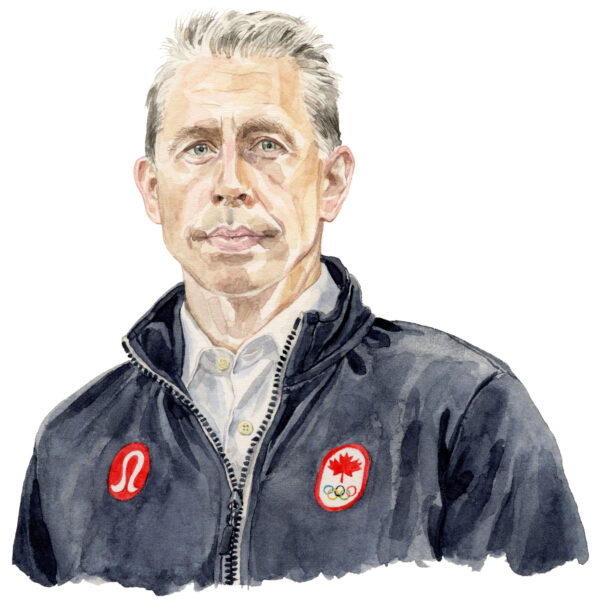
David Shoemaker, LLB‘96, left a high-powered New York law firm for a job in sports, a world that’s always been close to his heart. After stints with the Women’s Tennis Association and at the helm of NBA China, he returned home in 2019 to lead the Canadian Olympic Committee as CEO and Secretary General. Through it all, he has been guided by the same deep conviction in the power of sport—to unite, inspire and bolster well-being at all ages. Colleen MacDonald spoke to Shoemaker about his journey merging law and sport, the trajectory of Canadian athletes and what it’ll take for Team Canada to succeed at the Milano Cortina 2026 Olympic Winter Games.
Has sport always been a prominent part of your life?
My mom and grandfather were pro tennis players. He was the top player in Canada in 1933 and my mom won the Canadian Open in doubles in the era of Billie Jean King. From a young age, I had a passion for virtually every sport. If there was an Olympics for the school yard, my brother and I would’ve captured gold. At Western, I played intramural basketball, ball hockey, ice hockey and touch football. To this day, I find it so important, not just for my physical fitness, but for my mental well-being, to have sport as an outlet.
You landed a Supreme Court position right out of law school—an impressive feat. What gave you the leg up?
It was the experience of a lifetime. Western Law put me in a really strong place, through both the pedigree of the school and the education I received. A year later, on a whim, I decided to see if there was any interest from New York law firms. Cravath, Swaine and Moore took a chance on me. They hired exclusively from the U.S. Ivy League schools—no exaggeration—and I’m proud to say my Western degree and the training it provided completely stacked up.
What drew you to the administrative leadership side of sport, where the successes may not be so publicly celebrated as athletic victories?
A love of sport and a belief in its power. I’m living it. My Olympic moment came in 1980 with the Lake Placid Winter Games. I was nine years old and an aspiring alpine skier. The nation’s hopes were riding on Ken Read, and my parents let me stay home from school to watch him race. But he crashed after his binding released. We felt shattered. But then Steve Podborski saved the race for Canada, capturing bronze, one of only two Canadian medalists at the Lake Placid Games. I wanted to be just like him, so I delivered newspapers and shovelled snow like an Olympian, so I could help pay for my own skiing and justify taking time off school for ski racing.
We have an expression here: ‘Be Olympic.’ Podborski’s win encouraged me to be Olympic in everything I did throughout my life, including when I wasn’t working in sport. When I had an opportunity to combine my legal profession with the sporting world, I jumped at the chance.
How did that happen?
I was working for Proskauer, a New York firm that had the world’s preeminent sports practice. Many professional leagues and teams were my clients. I was teaching sports law class at two universities in New York and New Jersey, and I was in my partner year at the firm. I was offered the opportunity to join the Women’s Tennis Association as its general counsel—for a massive pay cut. I took it.
My colleagues thought I was crazy, but I took the chance because I wanted an inside role in sport’s capacity to shape lives for the better. Perhaps I also thought, ‘This will make my mom and my grandfather proud.’
What’s a typical day like for you at the Canadian Olympic Committee?
There isn’t one. On my first day with the COC, I showed up and Steve Podborski was on the board! I thought, ‘Wow, here I am sitting next to the guy who defined my Olympic dream.’ I work very closely with many athletes who are or will become Canadian icons.
My day-to-day also involves a heavy dose of interaction with government, as we advocate for more funding for the sport system, and frequent interaction with the private sector, because the COC is almost 100 per cent funded privately via 37 marketing partnerships or sponsorships with very supportive Canadian companies. And now, a significant part of my day is preparing Team Canada for the Milano Cortina 2026 Winter Games in Italy.
You’ve been a strong advocate for boosting federal funding to Canada’s 62 national sport organizations that haven’t had an increase in core funding since 2005. Why is it so critical?
The COC is an honest broker in this conversation, because although we’re almost entirely funded through the private sector, we advocate for the federal government to invest more in national sport organizations so they’re able to support athletes at all levels of sport.
Sport can have a tremendous positive impact—and not just supporting Olympic dreams. Sport is good for both your physical and mental health. Sport brings communities together across a huge country. It unites us. It inspires us. It teaches life lessons on how to lead and persevere, even under adversity. And it teaches not just how to win, but how to lose. The power of sport is worthy of the federal government’s time and investment. The sum of money we’re talking about is an incredibly efficient way of investing in the well-being of this country.
Amid global turmoil and the polarized political climate, what role does sport play?
It has an enormous role. I saw it firsthand in Tokyo after the 2020 Olympics were delayed a year by COVID-19. When the world finally came together, it was incredibly cathartic and inspiring. When we won our first medal, the silver in the women’s swimming relay, and then London’s own Maggie Mac Neil won gold in the butterfly, the country erupted with excitement. The women’s soccer team went on to win gold, Kelsey Mitchell won in track cycling and Damian Warner, another Londoner, won the decathlon. It was incredible, and it wasn’t just a Canadian experience; the world was experiencing it.
Now as we’re feeling challenges to our sovereignty, patriotism is on the rise. Canadian athletes who’ve been training throughout their lives to represent this country are competing with the maple leaf on their chest, doing us proud. So there’s a little extra riding on sport now. But at the end of the day, we shake hands and move on. It’s the last thing on Earth where the world comes together in that spirit. It’s real, not idealistic—sport can bring the world together, even in times of real tension.
What is the COC doing to develop the next generation of athletes?
Over the next 10 years, we’re going to get a million more young people in Canada into organized sport. We think if no one else is doing it, we ought to.
If we’re going to continue to be competitive and grow our Olympic performance, we must radically broaden the base of athletes who are getting into organized sport in Canada. Facilities are getting harder to come by, clubs are harder to get into and participating is very expensive, even in sports you might not think of as costly. We’re committed to trying to change that by lowering the barriers so a diversity of Canadians can access organized sport.
With mental health increasingly a challenge facing elite athletes, what is the COC doing to help?
Many high-profile athletes have joined the conversation on the importance of being mentally well to compete. We agree. It’s important to destigmatize mental health issues so people are willing to seek help, and then, it’s equally important to have the support in place. That’s why the COC and Canadian Paralympic Committee have partnered for over 10 years with Deloitte on a program we call Game Plan. It evolved from a performance tool to help athletes show up at the starting line free from mental pressure into a total wellness resource centre including mental health support for all our athletes.
How do we ensure athletes are competing in a safe environment?
Abuse and harassment cross all sectors, but in sport we’d been letting national sports organizations decide for themselves how to respond to allegations. That was the wrong approach. It needed a national solution that I’m happy to say is now in place. About three years ago, Canada established an Office of the Sport Integrity Commissioner where athletes can take complaints of abuse or harassment and have them investigated and adjudicated independently.
What still needs to happen is that all provinces—not just some—must create similar provincial bodies. The reality is the national body is responsible for about 3,000 athletes who compete and train at the national level, but the majority of sport takes place at the club level in cities, so we need alignment across the country. It has begun, but not with the level of energy that it should.
What moment stands out for you from your career?
I was in the stadium with my wife and three boys when the Canadian men won the gold medal in the 4x100m relay in Paris. That team believed in themselves, when few others did. The moment crowned an illustrious career for Andre De Grasse. What made it even more special was seeing them come around with the flags draped over their shoulders, celebrating for Canada. Bruny Surin was in the crowd right near us. Everyone in his section went over to Bruny and hugged him, because he had won the 4x100m in Atlanta in 1996.
We were sitting behind Kamala Harris’s husband, Doug Emhoff. He was representing the U.S., but he had to begrudgingly high-five us when we won.
Beyond medals, what other ways should we measure the success of Canadian Olympians?
Even when we don’t win, our athletes represent Canadian values and give their all every competition. We lead the world in that. One of my favorite Olympic moments was a heartbreaking one at the Tokyo Olympics, when our women’s 4x400m track team came fourth. I’m getting emotional just thinking about it. The way those women put their arms around each other and expressed such raw emotion. It was so hard to hear them say they felt they let the country down. And then they said they were going to come back and go for the podium. I was as proud of them in that moment as if they’d won the gold medal.
I think we should also measure Olympians by what they’re doing off the field of play. Many of our athletes are devoting significant time to their communities or to sustainability in the Olympic movement.
What are you most looking forward to at the winter Olympics in Milano?
I’m looking forward to seeing Mikaël Kingsbury in freestyle skiing moguls. He’s probably the most successful skier in our country’s history, and I’m not sure enough Canadians know that. We should all watch what speed skater Isabelle Weidemann has in store after winning gold, silver and bronze in Beijing. We’re also a powerhouse in short-track speed skating. Our snowboard athletes are incredible and our figure skaters are world class. I’m especially looking forward to seeing double gold hockey performances for our women’s and men’s teams. We own winter and I can’t wait to see that.
Learning Mandarin, a daunting challenge for many English speakers, sounds like a potentially onerous prerequisite for your role as CEO at NBA China. How did you acquire fluency?
It was a survival skill. I lived in Beijing outside of the international hotels, where no one spoke English. I found out the hard way that no matter how many times you yell, ‘Stop!’ at a taxi driver, he wasn’t stopping if you don’t know ‘stop’ in Mandarin.
I started with a Chinese-to-English dictionary, and learned ‘stop’ before becoming a master of vegetable names for restaurant dining. When I traveled back and forth between China and North America, I brought long lists of words with the Chinese equivalent written in English characters. For hours and hours on those flights, I memorized words. And then I had a tutor come to my office three times a week. I treated it like a business skill, as necessary as all the others I was trying to acquire at that time. And living immersed in another language helped me pick it up pretty quickly.
What has the COC been doing to increase the representation of women across more sports and across more areas of sport?
Proudly, I can’t tell you the last time we had more men than women on the Canadian Olympic team, or when we had more male medalists than female medalists. We are a team led by women. The Canadian Olympic Committee President, the chair of my board, is four-time Olympian Tricia Smith, LLD‘23. We’ve been intentional about gender diversity to show it’s not only possible, but necessary, and it’s not hard at all because there’s such a wealth of excellent women leaders in the country. Stacey Allaster, a Western Ivey grad who leads the U.S. Tennis Association, is on our board.
With technology advancing at the pace it is, how do you see innovations like AI and wearable sensors shaping the future of sport in Canada?
One of the greatest technologies I think we can help supercharge is athlete identification. We have a program in partnership with RBC called RBC Training Ground, which has been really successful in identifying and developing athletes. Two stick out in particular. Kelsey Mitchell was a soccer player, but RBC training ground showed she had incredible power in her legs, suggesting she might be better suited as a track cyclist. Four or five years later, she won the gold medal in cycling at the Tokyo Olympic Games.
Avalon Wasteneys had a similar result. She switched from cross country skiing to rowing, and then won gold with the women’s eight team in Tokyo. I believe AI will alter that landscape further, so RBC Training Ground can have a real multiplier effect and get to communities all across Canada to identify athletes. And that’s just one of many ways AI can assist the Olympic movement.
When you started with the COC, did you have particular goals you hoped to achieve through your tenure?
Not to mess it up! I say that somewhat tongue in cheek, but the Canadian Olympic movement has always been near and dear to me. Honestly, I inherited an organization that was on a great path with iconic Olympic performances and a really great brand. I saw my role as continuing that upward trajectory. The most obvious currency we deal in are medals, and we’ve seen that increase both across the winter and summer. Another goal of mine was to raise the brand profile to increase support from the private sector through marketing partnerships. We’ve done that with four premier national partners in RBC, Bell, Canadian Tire and Lululemon. I also want to see Canada be the nation that best represents a full commitment to both winter and summer performance at the Olympic Games.