From gene-edited potatoes to solar-powered growing systems, researchers are engineering crops and environments to withstand a changing climate.
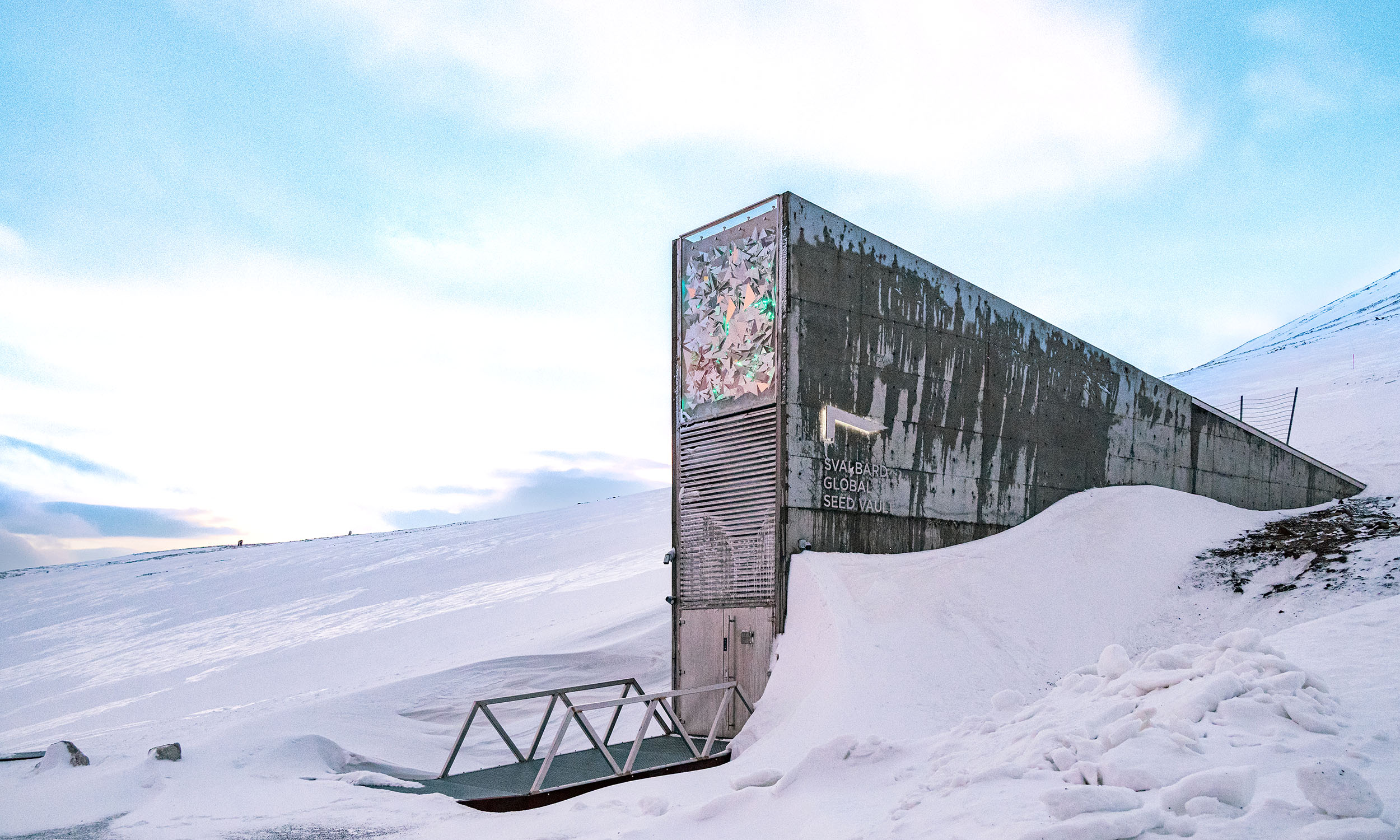
North of the Arctic Circle—buried 100 metres deep into a remote Norwegian mountainside—the Svalbard Global Seed Vault safeguards more than 1.3 million seed samples, conserving 13,000 years of agricultural history.
Providing long-term, climate-controlled storage (-18 C) for samples of seeds from around the world, Svalbard secures the international food supply against war, sabotage, disease, severe weather and the most probable: human mismanagement (epitomized in the 1840s with the Great Irish Potato Famine and the death of one million people). The Global Seed Vault, completed in 2008, was entirely funded by the Norwegian government for approximately $12 million and yet storing seeds there is free.
While it may sound like an elevator pitch for the next Christopher Nolan blockbuster, it’s all real and unfortunately, these seeds may be needed far sooner than anyone involved in the project ever expected. The climate crisis and its consequences on food security loom large, but mass insect infestation or fungal, viral or bacterial plant disease also pose significant threats to the world’s agriculture. In fact, one country has already made a potentially population-saving withdrawal from the seed vault’s collection.
Scientists from the International Center for Agricultural Research in the Dry Areas (ICARDA) retrieved seeds from Svalbard during the Syrian civil war in 2015. They wanted to regenerate new samples in Morocco and Lebanon in case Syria’s seeds were destroyed during the conflict. The toll didn’t reach the level of annihilation predicted and crops continued to grow, but the effort proved saving seeds for the future is one solution to food security when faced with a real-world threat. Why? Because it all starts with a seed.
“No seed, no food. That’s the easiest way to put it,” says Isaac Luginaah, co-director of the Western Centre for Climate Change, Sustainable Livelihoods and Health. “If you don’t have viable seeds, you’re toast. And if you have the wrong seeds, you’re toast. And if seeds cannot grow in available soil and conditions, you guessed it, you’re toast.”
You’re also toast if you can’t physically get to the seeds tucked away in Norway for safekeeping. Like most things in life, there are haves and have-nots. While Luginaah concedes the seed vault is a solution for some (let’s call government, big business and even academia the haves), the have-nots are going to be left high and dry. Pun intended.
“Do you really expect them to have every single seed from every single unique variety from every single growing condition and climate?” asks Luginaah, a geography professor. “Even if they do, how is a farmer from my small village in Ghana going to ever know they exist or, more importantly, have access to getting some? It’s a solution for some but not the many.”
For the past decade, Luginaah and his collaborators, many based in Africa, have used traditional agroecological practices to help growers mitigate challenges caused by climate change and government programs like mono-cropping—planting and growing the same crop, year after year, on the same plot of land, without crop rotation or diversity. These programs are intended to help farmers, but in the long-term, end up hurting them and the people they feed.
One solution Luginaah and his team have proposed is promoting traditional social networks that farmers keep between family, friends and neighbours. Everyone shares seeds, which inherently boosts crop diversity. It works, but not everyone has a social circle with which to share. It also leaves the network vulnerable. If drought or flooding occurs, it likely means those closest to you are also affected.
Luginaah believes there’s an even simpler approach—one that’s available in each individual farmer’s parcel of land. The idea, he says, doesn’t cost any money, requires no government support or new expensive technologies, and it could start, literally, today.
Many, if not all, smallholder farmers do the same things: they cultivate their gardens with mulch or fertilizer, they grow, they harvest, they eat, they throw out any organic residue (straw, sawdust, wool and manure) and compost what they can. All in the same field. Luginaah doesn’t want them to change a thing. Just do the steps more methodically. With purpose.
The living labs Luginaah and his team have planned, starting with a project in Malawi, would test different approaches of agroecology like composting or intercropping (the practice of growing two or more crops simultaneously) in isolated plots within each field. Then farmers plant the same crop in all plots, water, watch and learn.
“If Malawian farmers track growth and yields, they’ll know what works best where,” says Luginaah. “And if they adopt this method, the benefits could be boundless.”
Imagine which threats can be avoided if farmers simply knew the ideal growing conditions to maximize yields of a specific crop. It ensures the farms are far more resilient—a magic word when it comes to food security.
Luginaah is passionate about supporting smallholder farmers because such approaches can be easily scaled and shared with an open-source ethos across the continent and around the world.
“They don’t have to rely on foreign or private investment or new, expensive infrastructure. They just need to modify the way they do things, slightly, and we think the results will be well worth it,” says Luginaah. “It’s a simple solution to a big problem.”
If these new methods prove successful, the next stage may be super-sizing what local farmers can actually grow in their experimental fields. Globally, the “big four” crops (corn, rice, wheat and potatoes) alone account for almost 60 per cent of the world’s calorie intake. The downside is these foods aren’t very nutritious. Foods like salmon, kale and berries are more nutrient-dense options, providing more vitamins and minerals. These help you feel full with fewer calories, and are essential for disease prevention, weight management and overall health.
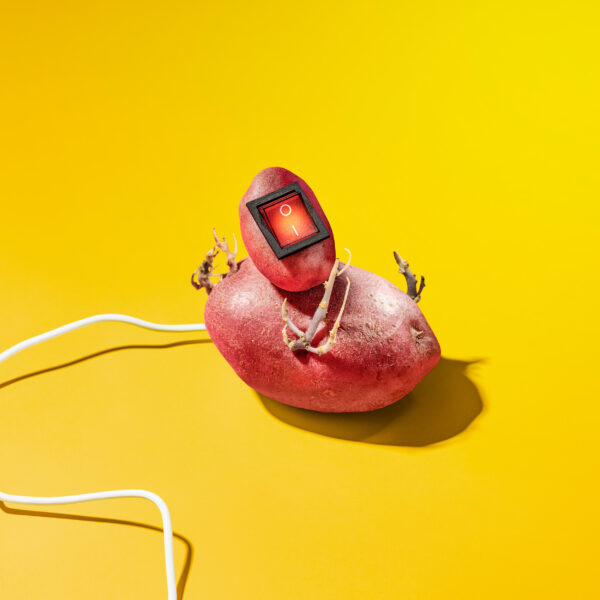
Potatoes, the only non-grain in the group, are the most nutritious—rich in carbohydrates, potassium and vitamin C—but are also high in sugar and starch. What if their nutrient density could be supercharged? And what if they were easier to grow and more resilient to climate change, drought and disease?
Traditionally, generating new crop varieties with these characteristics takes generations of plant breeding efforts. Schulich School of Medicine & Dentistry’s Bogumil Karas dreams of a far more targeted approach, one confined to science fiction novels he read as a child growing up in 1980s Poland.
The recipient of a $1.5-million grant from the Advanced Research and Invention Agency (ARIA), the U.K.’s research and development funding agency, Karas and his team are designing and building new plant chloroplasts—microscopic compartments of a cell that act like solar panels, turning sunlight into the energy plants need to grow. For now, he’s working with potatoes (other fruits and vegetables are on the horizon) to provide enhanced traits like resiliency and nutrient density. How do they do it?
Working in Western’s Biotron Experimental Climate Change Research Centre, Karas and his team are harvesting plant cells from Desiree potatoes (the popular, red-skinned variety) to create protoplasts, “naked” cells with the cell walls removed, so DNA—with the new desired trait—can be easily delivered. The new cell then regenerates into the plant.
The end goal—representing ARIA’s overall mission for this project—is to create new technologies that can be applied to various crops and generate variants for different purposes, like adding nutrients or making plants self-fertilizing.
“Once we fully understand the function of each gene, rewriting DNA would allow us to create hardier, virus-free potatoes, or whichever plant or vegetable you choose, modified to thrive in different climates and resist diseases and pests,” says Karas, a biochemistry professor.
Like Luginaah, he doesn’t necessarily want to rush new technology into the fields.
“We are in a unique era where we can start creating life from scratch,” says Karas. “But just because we can, doesn’t mean we should.”
ARIA-funded initiatives involve consultation with independent bioethicists who examine a range of social and moral considerations around synthetic biology and what’s needed to introduce them into native soils.
“As we develop this technology, we need to be asking key questions,” says Karas. “Who will own the seeds? What impact will the new potato have on the soil? And how easily will farmers in small towns be able to access this new variety? We need to ask these questions before we get to the end, because then it will be too late.”
Sure, ethics and due diligence may offset speed of development, but the project remains a climate change-busting alternative to traditional plant breeding techniques. And while it’s early days, Karas and others clearly have a plan for making a potato—already considered a robust and adaptable plant—capable of growing in a wide variety of soils and climates.
But potatoes still require the five essentials of growth: air, water, nutrients, space and sunlight. If one or more of these are missing, to quote Luginaah, “You’re toast.”
Not necessarily, says Joshua Pearce. What if we bring the climate and the right conditions directly to the plant? That’s exactly what he’s doing with the Western Innovation for Renewable Energy project.
Pearce, the John M. Thompson Chair in Innovation at Western Engineering and Ivey Business School, and his Free Appropriate Sustainable Technology research group have developed a net-zero energy farm that extends the growing season for berries and leafy greens like romaine lettuce and Swiss chard (all packed with vitamins, minerals and antioxidants) and is already greatly exceeding average traditional agriculture yields both indoors and outside.
Pearce’s latest project shows yields of more than 200 per cent above the average for romaine lettuce grown outdoors. Indoors, 1,000 square feet have the same output as 10 conventional acres of farmland per year. The award-winning system strengthens food security and sharply reduces the impacts of flooding, drought, pests and disease.
“We absolutely annihilated our controls. We just had a super-hot summer in Ontario and lettuce doesn’t like that, but the ones we planted under solar panels survived and thrived,” says Pearce.
The future-proof farm combines solar photovoltaic panels shielded outdoor with an agrotunnel, an indoor growing system that houses vertical aeroponic (growing plants in the air) and hydroponic (growing plants in water) units that use high-efficiency, spectrally optimized LED grow lights.
“Our solution provides an extremely high-density, resilient method to obtain year-round healthy fruit and vegetables at a minimum production cost,” says Pearce. “The system is modular, scalable and adaptable to various locations and extreme climate conditions.”
What if the nutrient density of potatoes could be supercharged? What if they were easier to grow and more resilient to climate change, drought and disease?
The system is built on agrivoltaics, a fusion of ‘agriculture’ and ‘photovoltaics.’ While harnessing solar energy, arrays of panels are also used as shields to protect the outdoor plants from extreme weather, creating a microclimate to conserve water. Equally important, photovoltaics also provide all the electricity needed for the agrotunnel to run the lights, water pumps and heat pumps used for heating and cooling.
Inside the climate-controlled agrotunnel, berries and leafy greens are monitored with artificial intelligence, including computer vision systems, to identify disease and ripeness, measure moisture, carbon dioxide levels and high-energy efficiency. Food crops are also tested and monitored in outdoor agrivoltaics systems under different transparencies, colours and types of solar cells to find optimal conditions for outdoor growth.
All of this makes the agrivoltaic agrotunnel an ideal environment to further Karas’ innovative work with potatoes and other synthetic plants, as prime growing conditions can be curated despite what’s happening in the great outdoors.
“We’re seeing higher and higher temperatures. This summer, we had to pause our traditional greenhouse experiments because it was just too hot. So yeah, we have a problem,” says Pearce. “We can assume temperatures will continue to rise, so what does that mean for growing? It’s almost all bad. Anything temperature sensitive, like lettuce and strawberries, is in real trouble.
“Clearly, the future of growing must include protecting our food in some way. Whether it’s in a traditional greenhouse, an agrotunnel or shading with solar panels. By far the most profitable way is agrivoltaics. Just cover your fields with solar panels in a way that’s ideal for that particular crop in your location, then earn money off higher yields and solar electricity.”
Sow the seeds. Genetically modified or otherwise. And reap the harvest.
Continue reading:

● Farming the future →
● Politics of the plate →
● What we know, what we eat →
● Scraps and solutions →
Next: