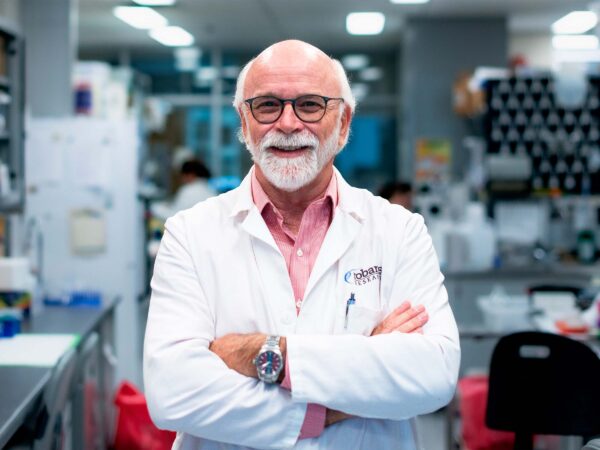
A Western research team, led by Dr. Michael Strong, is making significant strides towards curing ALS (amyotrophic lateral sclerosis).
Their study, published in the journal Brain, found that targeting an interaction between two proteins present in ALS-impacted nerve cells can halt or reverse the disease’s progression. The team also identified a mechanism to make this possible.
“This interaction could be key to unlocking a treatment not just for ALS but also for other related neurological conditions, like frontotemporal dementia,” says Strong, who holds the Arthur J. Hudson Chair in ALS Research at the Schulich School of Medicine & Dentistry. “It is a gamechanger.”
ALS, also known as Lou Gehrig’s disease, is a debilitating neurodegenerative condition that progressively impairs nerve cells responsible for muscle control, leading to muscle wastage, paralysis and, ultimately, death. The average life expectancy of an ALS patient post-diagnosis is just two to five years.
“It’s been 30 years of work to get here, 30 years of looking after families and patients and their loved ones, when all we had was hope. This gives us reason to believe we’ve discovered a path to treatment,” says Strong, a clinician-scientist who has devoted his career to finding a cure for ALS.
The next step is to bring this potential treatment to human clinical trials in five years, supported by a new $10-million donation from the Temerty Foundation.

Former Queen’s exec named Western’s VP, University Advancement
Karen Bertrand joined Western as Vice-President (University Advancement) on Aug. 1. She is leading university-wide efforts to engage alumni and donors and manage fundraising initiatives to support students and key projects.
Prior to joining Western, Bertrand was Vice-Principal (Advancement) at Queen’s University where she led a team that raised more than $426 million over four years.
“There’s so much we can build on at Western. The incredible scholarly community backed by a brilliant 150-year history of innovation, a vibrant student population and strong connections between alumni, donors and the university. I’m honoured to help Western make an even greater impact in the future.”
Expanding food and family studies
Western’s newly established Brescia School of Food and Nutritional Sciences welcomed over 400 students this fall. The school offers undergraduate and graduate programs in food, nutrition, family studies and human development and makes the Faculty of Health Sciences one of the broadest interdisciplinary health sciences faculties in Canada.
“Not only does the school add expertise, but it also creates new opportunities for collaboration and opens doors for students to explore other areas of health and wellbeing they may never have considered,” says Jayne Garland, health sciences dean.
