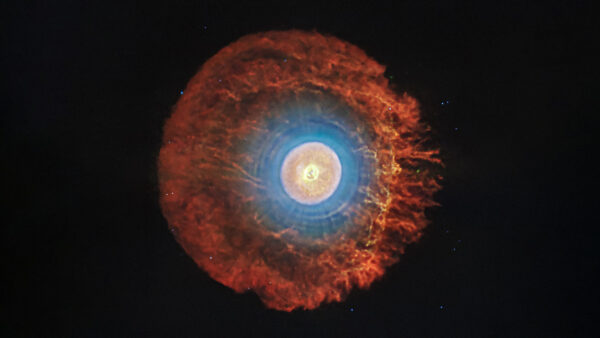
Fifteen years after Western astronomers first discovered “buckyballs” in space—soccer ball-shaped molecules that resemble a hollow dome—they’re back with stunning images built using the James Webb Space Telescope (JWST).
A team led by physics and astronomy professor Jan Cami first documented buckyballs using NASA’s Spitzer Space Telescope in 2010. The fantastic find came in the planetary nebula Tc 1, about 10,000 light-years away.
These molecules, which contain 60 perfectly arranged carbon atoms, were first synthesized in 1985 at the University of Sussex by Sir Harry Kroto and his colleagues—a breakthrough that earned the 1996 Nobel Prize in Chemistry.
Now the Western team has returned to Tc 1, this time armed with the JWST—the most powerful space telescope ever built. The new image reveals shimmering shells of gas across the frame (hotter gas glowing blue, cooler material traced in red).
“It shows we had only scratched the surface,” says Cami, principal investigator of the new JWST General Observer program. “The structures we’re seeing now are breathtaking and they raise as many questions as they answer.”
Discovering buckyballs in space helps scientists track carbon chemistry, explain mysterious signals and understand how organic materials change in extreme environments. Their discovery has also challenged traditional views about space chemistry and offered clues about how life may have begun.