
It was 1997. Schulich School of Medicine & Dentistry professor Eric Arts, BSc’90, still early in his career, was working as a virology chemist at one of the top-ranked medical research institutions in the United States: Case Western Reserve University in Cleveland, Ohio. Arts enjoyed the work but sitting in a lab with no windows, day after day, he knew there had to be more. And there was. It was only 12,000 kilometres, the Atlantic Ocean and a trek across Africa away.
One day, there was a figurative knock at the door. In fact, it may have been literal. He can’t remember. Regardless, it was a knock that changed his life.
“I was originally hired at Case Western by two researchers at the very top of global health: Jerry Ellner, a tuberculosis specialist, and Adel Mahmoud, the world’s leading parasitologist,” recalls Arts. “They said, ‘We don’t know much about HIV in sub-Saharan Africa. Will you go there and help us set up some clinical studies?’ I thought, ‘This sounds cool. I’d love to be able to get out there and do something different.’ So, I stepped in and honestly, it’s where I made my mark.”
At the time—nearly two decades after the first outbreak of the ongoing HIV/AIDS pandemic, which has claimed more than 40 million lives worldwide—infectious disease doctors were doing their best to treat patients, but had only a few drugs that were not yet making a meaningful difference for people living with HIV. Epidemiologists were also trying to understand how the disease spread around the world, but few researchers were studying the virology or immunology of the disease, or how it developed and progressed in the body. Even fewer were focused on the region hit hardest by HIV: Africa.
Arts has been doing just that for the past 30 years with his colleagues at the Joint Clinical Research Center (JCRC) in Kampala, Uganda; originally, through a clinical partnership with Case Western, and now as an advanced research collaboration with Western University.
“What we found was just how genetically diverse HIV is,” says Arts, Canada Research Chair in HIV Pathogenesis and Viral Control. “You have 39 million people with 39 million different viruses, all under the umbrella of HIV. It’s the most diverse virus to ever infect humans, except for maybe Hepatitis C.”
Working with Peter Mugyenyi, founding director of the JCRC, and Mugyenyi’s long-time research partner and eventual successor Cissy Kityo Mutuluuza, Arts helped develop early studies at the JCRC in Uganda to expand HIV testing and established new tests to monitor and prevent resistance to the anti-HIV drugs.
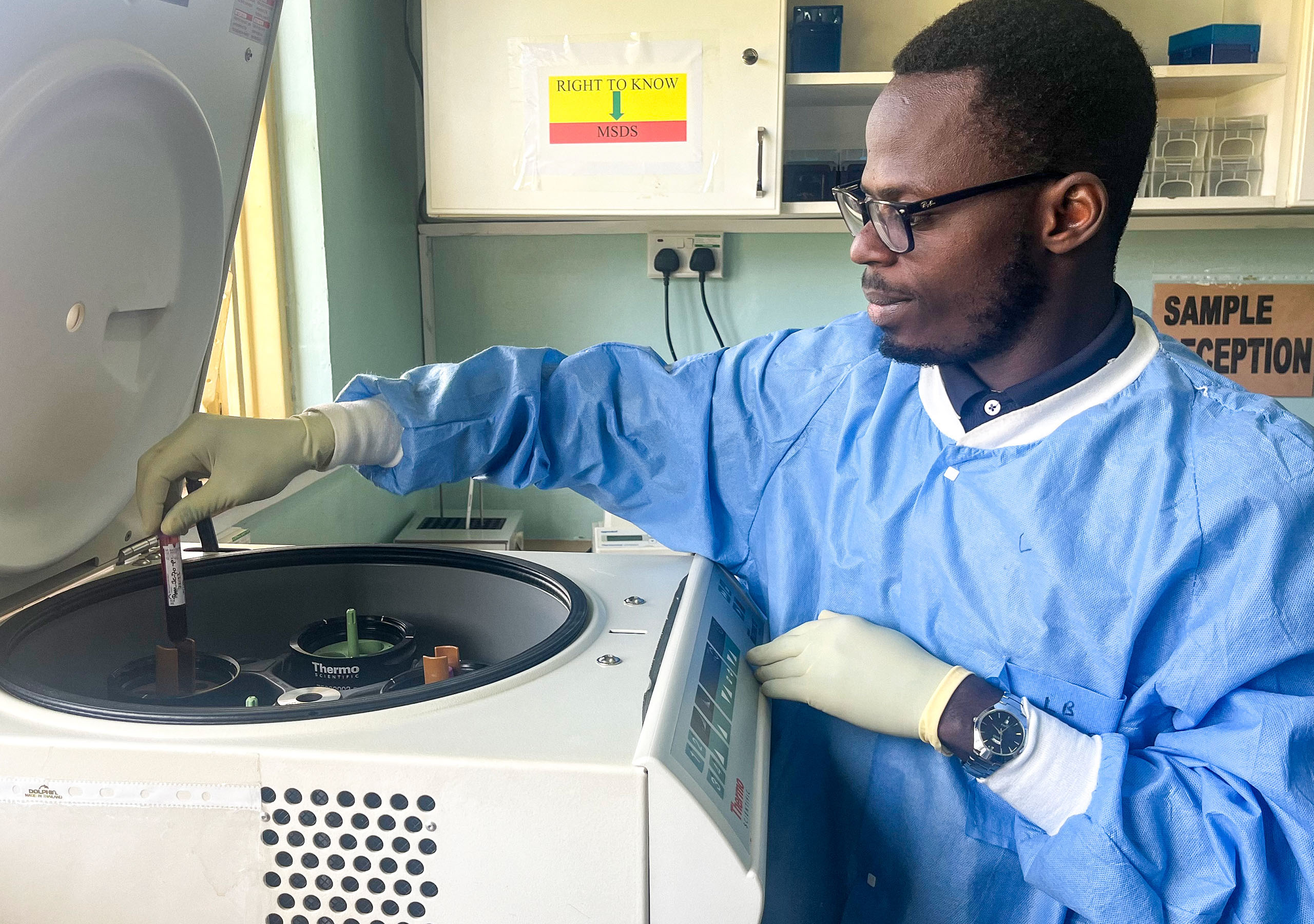
“The basic problem in Uganda, like much of sub-Saharan Africa, was that lab facilities just weren’t equipped to handle the complexities of HIV disease and future treatments,” says Arts. “Researchers were relying on science and very expensive tests developed in North America and Europe, hoping these would work the same in sub-Saharan Africa. And that became a huge issue.”
In the early days, the JCRC treated people in Uganda with new drugs and therapies as they emerged globally, but all the clinical bloodwork samples were shipped to the U.S. for monitoring and analysis. The work gave Arts, his collaborators and the broader global health community valuable insight into how HIV developed and spreads but offered no real benefit to the people living with the disease. Arts calls it “safari science.”
“In the U.S. and Canada, we were studying HIV for every individual patient to inform them, and us, about treatment for their specific strain of the disease. In Africa, samples were simply collected and shipped to the U.S. for analysis, bringing little benefit to the people who provided them,” says Arts. “New drugs are even being tested in Africa, but when they become available, people living with HIV there are the last to gain access.”
That, says Arts, had to change. With support from Mugyenyi, Kityo Mutuluuza—who received an honorary degree from Western in June—and the JCRC team, Arts established a Centers for AIDS Research (CFAR) laboratory at the JCRC to respond to these changes.
“One of the first things we did was provide actual treatment for those involved in our clinical study,” says Arts. “Before that, it was unheard of in Africa, which was a bit of a surprise to me. It took far too long, but eventually things did begin to change. Researchers from the U.S., Canada and Europe, including me, began setting up labs in sub-Saharan Africa. We started working with Ugandans to help expand their research programs and ensure they could secure funding to lead their own studies.”
CFAR is federally funded in the U.S. by the National Institutes of Health with a goal of enhancing and coordinating high-quality, multidisciplinary research on HIV/AIDS around the world. Another funding stream is the President’s Emergency Plan for AIDS Relief (PEPFAR), a global health fund first set up by President George W. Bush in 2003 to address the HIV/AIDS epidemic. When PEPFAR needed a framework for success, the Bush administration relied on the JCRC, through Mugyenyi and Kityo Mutuluuza, to make it happen. And did they deliver. This PEPFAR initiative has now saved the lives of more than 25 million with HIV in sub-Saharan Africa, thanks in large part to the JCRC. Unfortunately, these funding opportunities are now under threat.
“There are still lots of problems that exist. About 90 per cent of the people who need treatment for HIV in Uganda now receive it. So that’s fantastic, but it’s such a fragile situation,” says Arts. “We saw what happened this past year. Senators in the U.S. voted to keep PEPFAR funding, which was critical, but it was down to the wire. An estimated 500,000 people could have died in the first year if that funding was cut. That’s the extreme, but minor fluctuations in funding or mass global events like the COVID-19 pandemic all have a major impact on treatment availability and outcomes.”
That’s the bad. Here’s the good: PEPFAR and the Global Fund that provides HIV treatment remains intact—for now. Its important research and clinical care continue. Through Western’s Frugal Biomedical Innovations Program and Schulich Medicine & Dentistry’s Imaging Pathogens for Knowledge Translation (ImPaKT) Facility, a team led by Arts is working closely with Kityo Mutuluuza at the JCRC and Peter Zandstra, director of the Michael Smith Laboratories at the University of British Columbia, to develop an HIV cure.
“We’re combining our knowledge to develop and implement a cure for HIV,” says Arts. “We want to free people from having to rely on HIV treatments and extensive lab tests, so they can start living HIV-free. That way, they can’t transmit the disease anymore and the pandemic goes away.”
That singular goal is why Arts is so excited about Western’s new $44-million Pathogen Research Centre, slated to open in 2027. The centre will advance infectious disease innovation, enabling Canadian-made vaccines and biotherapeutics for clinical trials in Canada, Uganda and across the globe.
“Having this capacity in Canada is a major step forward for research and clinical care,” says Arts. “And while we await a parallel approach in Uganda, hopefully at the JCRC, we can partner with them and find solutions together at the Pathogen Research Centre for people in sub-Saharan Africa and around the world.”