My first book was supposed to be a novel.
Like most writers, I spent most of my life imagining everything about this first book—the work that would finally transform me from a writer into an author. Throughout high school, I had amorphous ideas for what this novel might be; a sharp, adventurous young adult book like the ones I loved reading, perhaps, or a sweeping work of literary fiction that would get me showered with endless praise.
As I worked through an undergraduate degree in English and writing studies at Western, the idea of writing a novel shifted from a dream into something that might actually be achievable. I applied to master of fine arts (MFA) programs, stating in my cover letters that my concentration would be fiction.
I plan to write a novel. I wrote these words over and over in my applications. And when I finally did start my MFA, my novel started to take shape. Then, suddenly, things shifted.
My first book finally came out earlier this year. Not a novel, but a memoir. And not by choice, but because of the startling and unexpected ways in which a life can change course.
During the first semester of my master’s program, I began to feel a light twinge of pain in my forearms whenever I typed. I immediately identified this as a repetitive strain injury. It was something I’d seen my girlfriend, a pianist, go through while we were at Western. Her pain, which turned out to be tendinitis, made it hard for her to perform or practice, and I watched the way her body held her back from what she loved. And so, when my own pain started, I took it seriously from the beginning. I immediately booked myself in to see a physiotherapist and took as much time off work as possible. Still, after a series of misdiagnoses and improper treatment, it worsened. This was all happening at the height of the pandemic, when the kind of testing or care I needed was considered non-essential, so landing at an actual diagnosis felt impossible. Physiotherapists cycled me through different potential answers, saying I might have carpal tunnel or thoracic outlet syndrome. Meanwhile, my symptoms worsened. Within a few months, the pain was so bad I could barely type.
Enter: Voice-to-text technology. You’ve probably used it before without thinking too much about it. Your hands are wet from washing the dishes, so you get Siri to send a text for you, speaking the words out loud and watching them form on the screen. This technology, which I’d used in little ways for years, suddenly became central to my life. As typing went from being painful to nearly impossible, I started relying on voice-to-text to write everything from school assignments to articles for my freelance journalism work. Everything I would do on a keyboard before was suddenly spoken aloud into my computer.
It took a long time to get the hang of this technology—to get my computer to understand me, setting down my words the way I intended. I bought an external microphone and learned to enunciate in a slow, computer-friendly way. Eventually, I was able to use voice-to-text smoothly. But there was an unexpected problem: my writing itself started changing.
We don’t talk in the same way that we write. Writers spend years—lifetimes, even—honing their written voice, finding a style and tone that suits their work. It’s not the same as the conversational, easy way we speak out loud. And so, when I started writing with voice-to-text, the way I wrote changed. My work sounded softer, more casual. Less practiced. I tried hard to capture the way I used to write, before my pain made me unable to do so. The harder I tried to speak the way I wrote, the worse my work sounded—a pale, awkward imitation of the way I actually wrote.
Throughout all of this, I kept trying to write that novel I’d always envisioned. I hated it. I wrote with voice-to-text, constantly frustrated at the fact that the book didn’t sound or feel the way I wanted it to. Instead of accepting that my written voice was simply changing, I continued to push against my new way of writing, struggling to make my work fit this idea I had for it. I wrote 20,000 words—a third of a book—this way and was flooded with shame every time I submitted a new chapter to my professors. I realize now what I was writing wasn’t bad. It was just different from what I was aiming for, from what I knew I was capable of. But at the time, I hated not being able to write in the way I always had and didn’t want to accept that the way I worked and sounded might have to change to suit my new physical limitations. The frustration I felt was so immense I took a year off school, resolving to return and finish my novel when I could type again.
As I learned how to write with voice-to-text, I also kept trying to solve the riddle of what, exactly, was wrong with my body. I’d eventually learn I was dealing with a crushed disc in my neck—the kind of thing that might never have become debilitating if it had been treated properly sooner. A diagnosis meant I could finally get better treatment and slowly start to ease my pain.
I never finished that novel. When I went back for the last semesters of my MFA, it was clear too much had changed. I still couldn’t type much, but had finally accepted the way I wrote was simply different now. Instead of pushing against it, striving for a voice and style that were no longer accessible to me, I leaned into it. I abandoned the novel and wrote a memoir instead, delving into what had happened to me with a level of humour and levity I couldn’t see when it first started. With voice-to-text, I wrote about writing; I wrote about graduating with a creative writing degree when I couldn’t type; about cooking when I couldn’t chop, moving into my first solo apartment when I couldn’t build IKEA furniture. I allowed myself to use the tools I needed without trying to keep writing the way I used to. And though I still grieved for my old life—one where writing was an easy, physical act—I allowed myself to enjoy the new one.
It’s been more than four years since my pain first started. My body isn’t completely back to normal, and will likely never operate at 100 per cent again. Though I can type much more than I used to (I’m typing this, now!), I still need to supplement it with voice-to-text on especially painful days. The key difference now is I’m allowing myself to work with these tools instead of against them.
I’m proud of my first book, though it’s not the first book I ever intended to write. And a few months ago, I finally started to write a novel again. It’s a completely new work—my old one is too tied up in negative feelings and grief to revisit.
This new novel just surpassed 30,000 words, meaning it’s longer than my first one ever got to be. And as I’m writing, I’m being gentle with myself, letting my work take shape the way it needs to instead of exactly how I’d envisioned.

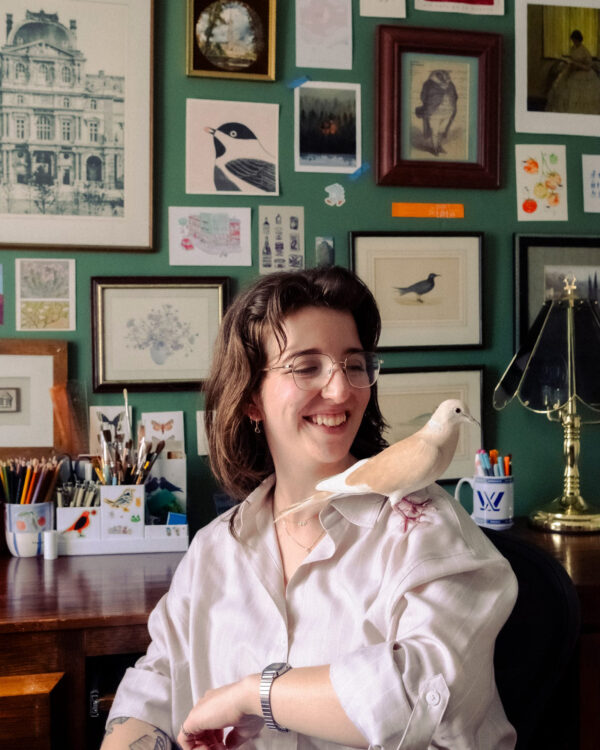
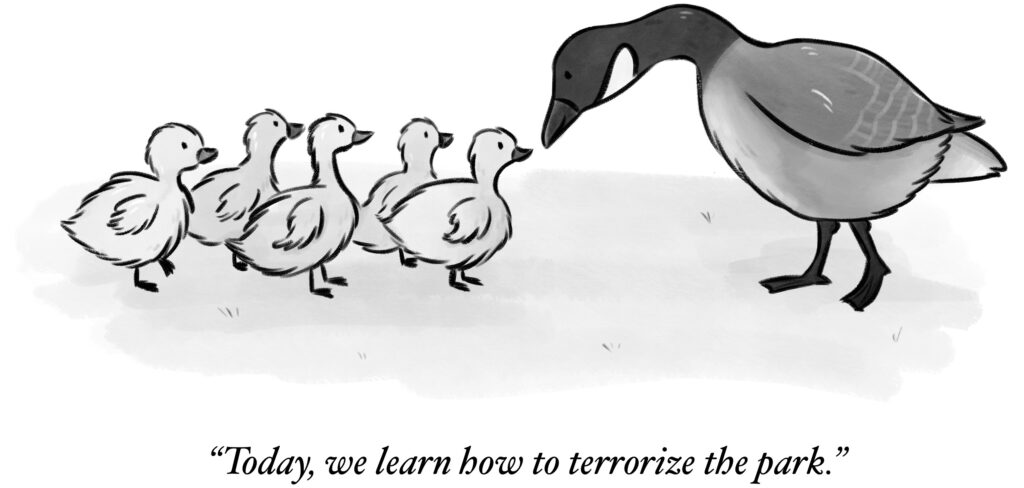
Gabrielle Drolet, BA’20, is a writer and cartoonist who earned her degree in English and writing studies at Western, where she also served as the 2019–2020 Student Writer-in-Residence. Her cartoons have appeared in The New Yorker and her debut memoir, Look Ma, No Hands, was published in May 2025.